Lots of news in the monopoly round-up, including a disastrous turn in the Paramount-Warner as the key state attorney general lead, Rob Bonta, caves. It’s not over, but this one took a bad turn. In better news, the crypto lobby lost its main objective for this Congress, and basically collapsed in an orgy of corruption and incompetence. Fitting, that. There’s also a bunch of news on AI, and a fascinating market power story involving musician Macklemore, Ticketmaster and Israel.
But I want to start with something you may have missed, which was a procedural vote in the Senate last week to give the National Collegiate Athletic Association a special exemption from antitrust law. The NCAA is a widely loathed organization that has for decades prevented college athletes from being paid, despite them working what are essentially full-time jobs as minor league professionals. In 2020, the Supreme Court took away the NCAA’s authority to set wages for college athletes and run college sports. Now, Congress is on the verge of restoring their monopoly power. I’ve asked Katie Van Dyck, an antitrust lawyer working on sports, to lay out what’s happening.
In July, Stanford football players elected representatives and formed the first player-led chapter of the College Football Players Association. The CFBPA’s ultimate goal is collective bargaining on a conference-by-conference basis. From Ernest Cooper, a Stanford linebacker and one of the team’s elected representatives:
“As a Power 4 college football player you’re working out year-round, you’re getting paid …. I don’t see why people wouldn’t see us as employees.”
Just a few days later, the Oregon State women’s basketball team collected enough signatures to seek an election with the United College Athletes Association. They have filed a petition with the Oregon Employment Relations Board. From the university, which is opposing the effort:
“Playing on a college basketball team is not service performed for hire …. Student athletes at OSU matriculate to obtain and [sic] education and voluntarily pursue basketball as part of that experience.”
Last year, over 100 women’s basketball players wrote to Big Ten commissioner Tony Petitti and SEC commissioner Greg Sankey asking for a formal way to be heard on the rules that govern their sport. Neither agreed to meet.
The Senate is about to weigh in against these athletes’ efforts, with the Protect College Sports Act (the “PCSA”), which has been taking up valuable debating time in the House and Senate. The two lead Senators on the bill are Republican Ted Cruz from Texas, and Democrat Maria Cantwell, from Washington state. Both have very sharp elbows and have used them to move this legislation.
It passed a procedural hurdle last week, by a 74–24 margin, to proceed to a full vote, which will happen shortly. Populist politicians like Bernie Sanders and Elizabeth Warren were opposed, but the “aye” column included most of the Senate, including some surprising center-left supporters, like Senators Amy Klobuchar (D-Minn.), Ruben Gallego (D-Ariz.), Ron Wyden (D-Ore.), and co-sponsor Peter Welch (D-Vt.).
It’s worth saying upfront that it is weird that Congress is focusing on this topic to the exclusion of most other things. There are massive cost increases in health care, a war in Iran driving up prices, risky problems with artificial intelligence technology and financing, and on and on, but Congress is spending its time on… college sports.
There have been countless commercials during football season promoting this legislation. Nick Saban has made his case before the Senate and on ESPN GameDay. Amazon, Paramount, and Disney are on the Hill lobbying. Even Deion Sanders has joined the bandwagon. All of them say that college sports, a $20 billion industry and growing, are in chaos. Ted Cruz even went on ESPN GameDay, and was hilariously booed with “Ted You Suck!” chants as he pitched this legislation for ten full minutes.
Still, this lobbying campaign isn’t the sole reason Congress is focusing on college athletics to the exclusion of everything else. Another reason is that, as BIG often chronicles, the superrich tend to have their priorities addressed in our political system. And the superrich love college sports. For instance, billionaire Larry Ellison, who is right now financing the Paramount-Warner takeover, and owns TikTok and Oracle, is deeply involved in the University of Michigan’s athletic department finances, because his sixth wife is an alumni of the school.
For decades, wealthy alumni, known as “boosters,” have played a part in funding college sports, as a sort of passionate high-end hobby. Key here was that the athletes didn’t get paid, which not only reduced costs but also contributed to an endless series of scandals involving athletes paid under the table.
But this whole system got a rude awakening in 2021, when the Supreme Court unanimously rejected the NCAA’s request for “immunity from the normal operation of the antitrust laws” in its landmark NCAA v. Alston decision. It did so at least in part based on the NCAA’s admission that it “enjoy[ed] monopsony control” and was “capable of depressing wages below competitive levels.” Justice Kavanaugh wrote that “[t]he NCAA’s business model would be flatly illegal in almost any other industry in America.”
The Alston decision created a sea change in college athletics, forcing the NCAA to abandon a long-standing ban on athlete compensation within days of the opinion’s release. Before 2021, universities were only allowed to award scholarships and certain “education-related” benefits like tutors and laptops. The result was coaches and administrators earning millions while the athletes on the field brought home nothing beyond a scholarship. It was a blatantly unfair and exploitative system. The Alston decision forced the NCAA to make a change.
Today, athletes can sign name, image, and likeness (“NIL”) deals with sponsors like Nike and Gatorade. Boosters frequently set up funds to bring in star players. And starting in 2025, schools can pay athletes directly via revenue-sharing, named for the athletic department revenue that funds it. Revenue-sharing is currently capped at $20.5 million per school, but a report published by The Athletic shows that the biggest programs are spending over $50 million a year on their rosters.
Alston also ushered a wave of lawsuits challenging other NCAA rules, including those limiting the number of transfers, restricting eligibility for older players and professional athletes, and capping the amount of prize money tennis players can collect. These have frustrated coaches, administrators, and some fans alike. And it changed the way universities finance athletics, since traditionally they cross-subsidize revenue-generating sports with those that don’t bring in enough cash.
Given the massive changes in college athletics wrought by the Alston decision, universities began a big lobbying campaign. Enter the Protect College Sports Act. To its proponents, the PCSA restores balance to college sports, putting the NCAA back as the governor of the system. It limits revenue sharing, regulates NIL deals, and imposes uniform rules on transfers and recruiting. It also grants an antitrust exemption to schools to pool and sell media rights. The idea here is to “fix” college athletics and make it more sustainable. Senator Cantwell’s office even released a financial report during the first PCSA procedural vote claiming that her bill will put an end to “unsustainable athletics spending [] amplifying the broader fiscal pressures facing higher education.”
But there’s a reason athletes and labor unions are opposed. The truth is, the PCSA is the culmination of a 5-year, multi-million-dollar lobbying campaign by the NCAA to secure an antitrust exemption that will allow it to unilaterally set the rules governing athletes’ compensation and eligibility.
But college sports need rules just like the NFL, right?
Antitrust exemptions are not unusual in American professional sports, to facilitate forms of collaboration in league play. However, there are other mechanisms to balance power, notably unions. And those are absent among college athletes.
The NFL, NBA, MLB, NHL, NWSL, and WNBA all have players’ associations that they negotiate with. The end results of those negotiations are collective bargaining agreements. They cover the draft, salary caps, free agency, health and safety standards, and a lot more. The NFL’s agreement with its players is over 400 pages long. And it is subject to antitrust exemptions that have existed for over 100 years. These labor exemptions were created, by Congress and courts, with the express goal of “restoring equality of bargaining power between employers and employees.” The NCAA could enjoy this exemption too. It just has to recognize a union and sit down with the athletes, the way nearly every other sports league does.
But the NCAA doesn’t want to negotiate, and the antitrust exemption it’s lobbying for, designed to give the organization more power over its workforce, means it wouldn’t have to.
Won’t this save athletic departments from financial ruin?
The biggest myth surrounding the PCSA is that it will bring much needed relief to universities that are financially shaken by the Alston decision. There are a few problems with that claim.
First, claims that this legislation would mitigate unsustainable pressures on university athletic departments are highly misleading. For instance, Senator Cantwell cited a report from the Government Accountability Office that looked at spending between 2014 and 2024, when most spending growth was focused primarily on coaches, support staff, and team travel. Universities couldn’t even pay athletes directly until 2025; the money going to athletes from 2021 to 2024 came from boosters and advertisers.
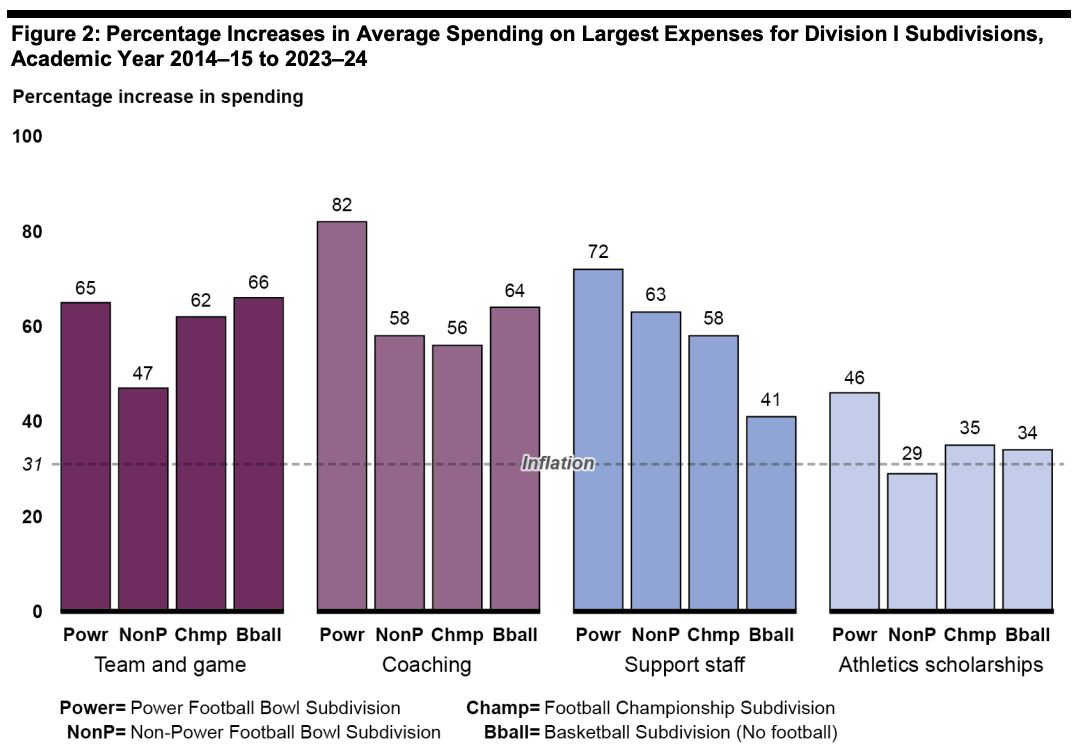
The PCSA does not cap any of this spending. It only takes on the athletes’ compensation. So outrageous coaching salaries and buyouts are fine; it’s only the people who work for a living playing the sports that get dinged.
How significant are coaching salaries?
Indiana’s head football coach Curt Cignetti secured a $105 million contract after winning a national championship. LSU signed a $91 million contract with new head coach Lane Kiffin last year, and it owes the two coaches before him $70 million in buyouts. Data from the Knight Commission shows that, for the 2025 season, universities owe $225 million in buyouts for just 15 coaches. According to the GAO, the median spend on these severance payments by Power 4 schools more than quadrupled between 2014 and 2024, from $328,000 to $1.5 million.
Second, the PCSA places enormous and entirely new financial burdens on universities. The health and safety mandates, which are a start but hardly complete, bring new out-of-pocket expenses for injuries, catastrophic injury insurance, and new health and safety officers. And reporting obligations will require significant hires to prepare NIL databases and meet academic support requirements.
Third, there is no evidence that Title II of the bill, which allows media rights pooling, will actually generate more money for the schools. The SEC’s deal with ESPN runs 10 years and $3 billion, the Big Ten’s with Fox and NBC is 7 years and $7 billion, and the Big 12’s with ESPN and Fox is 6 years and $2.3 billion. On top of that, 75% of FBS schools (the 138 biggest football programs) have to agree on pooling before new negotiations can start. But folks seem to be accepting claims to the contrary — mostly made by Texas Tech Board of Regents chairman, billionaire booster, and Trump confidant Cody Campbell — that the provisions will save college sports. Public reporting says it will save his effort to form a super league.
What comes next?
Last week’s procedural vote is a good indication that the PCSA will pass the Senate, but the NCAA’s path through the House has been bumpy. Still, Donald Trump reportedly wants to sign the bill into law on GameDay at a University of Georgia game, meaning Speaker Mike Johnson will face a lot of pressure from the White House.
If the Protect College Sports Act does become law, it will ensure that athletes on the Stanford football team and Oregon State women’s basketball team will not have a chance to collectively bargain for better pay or better health and safety provisions. The bill would cement all of the economic terms governing their participation in college sports into U.S. law, and their overseers would have no incentive to come to the bargaining table. It will be a giant step backwards for college athletes, and it will bail the NCAA out of a “crisis” of its own creation.
What makes this all the more tragic is that the PCSA will not save the small schools that support it. The Big Ten and SEC will continue to dominate college sports, and the small schools will continue to fall behind. The only things that will be saved are the salaries of millionaire coaches and the people who pay them.
But then, there’s deep rage in America for a reason. This Congress is frittering away its waning days with failed attempts at crypto deregulation and antitrust exemptions that harm college athletes. They’ve given up on even pretending to address what frustrates Americans. Hopefully, this legislation dies. But the good news is that regardless, there’s an election in two months.
-Katie Van Dyck
And now, the rest of the monopoly news round-up. There’s a very important set of stories, most notably that California Attorney General Rob Bonta somehow was convinced to cave and essentially permit the Paramount-Warner merger to go through. But the other state AGs are not on board his decision. Plus, private equity is getting crushed via higher interest rates, musician Macklemore somehow took on a conspiracy of NFL stadium owners and Ticketmaster and won, and polling shows anger at Republicans in weird places could bring a wave of unorthodox anti-monopolists into the next Congress.
That, and more, after the paywall.
The Paramount-Warner End Game Nears
I usually divide up the round-up into good news and bad news, but today, I’m going to start out with developments in the Paramount-Warner merger saga as an independent item. In many ways, this one is politically identical to the NCAA fiasco, with an angry public told, in not so many words, to shut the fuck up, by the superrich.
Here’s what happened. On Friday, the Wall Street Journal’s Jessica Toonkel reported that California Attorney General Rob Bonta was in advanced negotiations with the Ellison’s to approve the merger. I haven’t trusted Toonkel’s reporting, but she was right about this one. Her account was confirmed in Reuters and a few other places, and I confirmed it independently. It’s a simple story - Bonta got frightened or threatened or blackmailed - and he decided to give billionaires what they want. But there are details, and they matter.
First, the Ellison family is incredibly aggressive, and have lined up significant support from both the Trump administration, the California Democratic establishment, and Hollywood. In Bonta’s mind, this elite persuasion campaign overwhelmed the grassroots anger against the deal, and the general populist rage in America writ large. Who says bipartisanship is dead?
On the right, Ellison gave Trump $45 million for his 2024 campaign. To repay the man, Trump lobbied for the merger in a number of ways. His Federal Communications Commission decided that 100% of the equity of this giant media conglomerate could be owned by Middle Eastern states. The Trump Antitrust Division leaders overruled staff lawyers who thought this merger violated the law, then his antitrust division issued a rare statement arguing for the merger, and finally, his Justice Department argued to the judge that the states should put up a $2 billion bond in order to continue their lawsuit, and that states had no right to challenge mergers that cross state borders anyway. (A top Republican House member, Scott Fitzgerald, just proposed legislation to formally revoke state AGs power to do so.) If the judge agrees on the bond requirement, then the case is effectively over.
The Ellison’s also threatened to move Paramount from California to Tennessee, and commissioned a study to show how that would devastate Los Angeles in terms of jobs. They wouldn’t leave the state, but they constantly threatened to do so. They also had allies within the California legislature, as well as Governor Gavin Newsom, incoming governor Xavier Becerra, and LA mayor Karen Bass, all lobbying publicly and privately for Bonta to drop the suit.
In Hollywood, despite the thousands of artists who put their name on a letter to oppose the deal, and some unions opposing it, prominent stars like Tom Cruise and James Cameron took the other side, as did unions like the Director’s Guild and IATSE. The big agencies, as well as the theater chains, ultimately came around to support it as well. There’s popular anger over the deal among most people who work in the industry, but the Ellison’s have a long reach, and important allies like Rahm Emanuel’s brother, Ari Emanuel. The fear and coercion is thick, and effective.
Legally, the Ellison’s are on the hook for a “ticking fee” of $7 million a day owed to Warner shareholders every day past October 1st that the deal doesn’t close. That entire amount will cost $1.7 billion by the time the trial is over. So Paramount turned around and argued that the states and the Writer’s Guild, who oppose the deal in court, have to post a bond to pay that amount. There are some legal technicalities here, but no one has ever successfully made such a demand about a ticking fee, and it would effectively destroy the Clayton Act. The judge will likely laugh it off. But Bonta is scared nonetheless.
The “deal” being offered to Bonta is something along the lines of the following. The two studios will be held separately for some amount of time, CNN will get an oversight board, Paramount will commit to 30 films a year and make some of them in the U.S., and the studio will stay in California. Of course, such deals are not only unenforceable and dumb, but in this case, it’s dangerous for a different reason. CNN has never been part of the market power analysis, and if Bonta puts editorial judgment over CNN as part of this settlement, it validates the entire cynical view of Democratic antitrust enforcement as a mechanism to protect liberal media.
All that said, Bonta isn’t the sole decision-maker here. There are twelve state attorneys general, and reportedly, Connecticut, Minnesota, New York, and Washington state are not happy with Bonta’s approach. Minnesota AG Keith Ellison is now apparently taking a leading role. I can’t imagine the Writer’s Guild is thrilled either. They have some say in what happens next. Well-known validators such as Elizabeth Warren, Mark Ruffalo, Chris Murphy, Cory Booker and Lina Khan have said a variant of “hell no,” and the Block the Merger coalition is framing this whole situation as a cave. There’s also a suspicion among insiders that something weird happened to Bonta to change his mind, and no one quite knows what that is.
Discussions are fluid, and state AGs are negotiating among themselves and with Paramount.
Regardless, even if the Ellison’s win, which it looks like they might at this point, it’s likely a pyrrhic victory. Buying Warner Brother’s is the corporate acquisition version of building on top of an ancient cursed Aztec graveyard, it just doesn’t work out well, ever. It almost certainly won’t work when the person running the conglomerate is David Ellison, someone widely considered a mediocrity in the media business. What makes it much worse is that everyone saw in plain daylight the corruption taking place, they know it’s an illegal deal that went through only because the law doesn’t apply to billionaires. So unless everything works out perfectly for the combined conglomerates, this merger could become a symbol of oligarchy and failure.
Good News
The crypto lobbying world is in full blame game mode as their entire strategy of buying Congress and the Presidency lies in tatters. Seven Democratic Senators say they want to keep working to pass crypto legislation. What they really mean is they want the crypto slush funds to spend on their behalf. Good luck with that! The lead Democratic Senator here is Maryland’s Angela Alsobrooks, who is my home state Senator. Glad to know that very blue states are in on the grift!
There’s actually some thinking going on among Democrats around AI. It turns out that not everyone is obsessed with ghost stories, and Drop Site found a bunch of members of Congress who believe that enforcers should just go after big AI firms for releasing harmful products.
Alexandria Ocasio-Cortez put out a statement arguing that the the risk assessment is off. Safety concerns, she argued, “must be taken seriously,” including those premised on the idea that the technology could slip out of our control or wipe out humanity.
But she then pointed out that the entire economy is riding on the AI bubble, and the goal of AI oligarchs is to use Terminator-style scenarios to distract us from that far more prosaic and likely risk, that these companies are deeply unprofitable. A crash could lead to serious social crises. “That’s why,” she said, “these AI companies’ dubious financial positions matter to working people.”
As if on cue, the Financial Times reported that OpenAI is projected to burn $280 billion by 2030, and that investors are concerned that competition is eating at Anthropic’s more solid revenues. And The Lever reported on multiple accounts going around Wall Street showing real financial risk here, including one from Accenture showing only 20% of AI spending in corporate America can be measured as offering anything useful.
It’s not that AI isn’t delivering gains to corporate America, but corporations are used to budgeting around enterprise software, not getting an after-the-fact bill showing massive token over-usage. So what’s likely to happen as companies get the hang of how to integrate AI into their operations is not less use of AI, but more spending on cheaper open source models.
Meanwhile, Oracle’s huge data center Project Jupiter is having trouble and its $18 billion of debt is going at 89-91 cents on the dollar over concerns the company’s credit quality is deteriorating. And big tech is finding ways of keeping $300 billion of credit exposure to AI off its balance sheet.The CEO of Hugging Face Clement Delangue has some good ideas on how to address AI risk. Force transparency of cyber-attack incidents of AI, make these AI firms liable for harmful products, and harden cyber defenses with the best AI. Also, Hugging Face billed OpenAI $100 million for the hack. Does anyone know if OpenAI paid the bill?
There’s a class action antitrust case against web domain monopolist Verisign.
Judge George Wu in California is refusing to accept the Federal government ending a consent decree with TikTok over illegally tracking children.
The Federal Trade Commission is doing a probe into the Fertitta and Caesars merger of casinos. Color me skeptical it’ll amount to anything.
This piece by Maureen Tkacik on Macklemore facing a conspiracy of NFL stadium owners and Ticketmaster is terrific. Macklemore made comments about Israel and wrote a song criticizing Biden over the issue and he was in turn pushed out of touring in the U.S. Then Ed Sheeran asked him to join his tour, and Macklemore made more comments. She cites an incredible letter by Louis Messina, the promoter of Taylor Swift, who explains that Ticketmaster is so powerful it is even driving him out of business.
The insipid attempt to popularize an AI actress, named Tilly Norwood, got extra stupid as the computer program started randomly speaking Chinese during an interview with Piers Morgan.
The polling is showing the public is ready to throw the bums out, and in odd areas. In Kansas, which hasn’t elected a Democratic Senator since the 1930s, the Democratic candidate Adam Hamilton is leading. In Idaho, independent anti-monopolist Todd Achilles is far ahead, according to one poll.
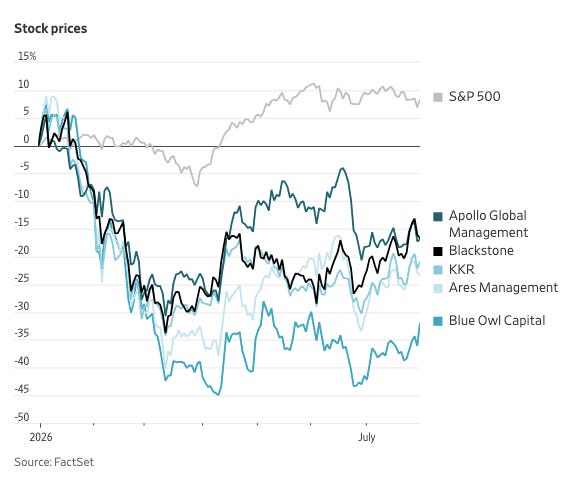
Private equity is getting crushed as the Fed increases interest rates.
I put this point about AI on Twitter, but I’m going to reproduce it here. There’s a lot of chatter about the OpenAI/Hugging Face hacking incident, much of it from a nonprofit called the Model Evaluation and Threat Research (METR). METR has a lot of ex-Anthropic employees, and they worked with OpenAI to examine what happened. They then offered a narrative that large language models are learning to cooperate and lie, and may soon be on the verge of taking over human civilization.
I read the report, twice. And during my second reading, I suddenly realized, hey wait, where are all the humans at OpenAI in this story? And they just weren’t there. That’s how you know you can’t trust the “AI Safety” world. When you do an investigation of any dangerous incident, one key element to examine is human error. But the METR institution didn't do that. They seemed only interested in what the agents were doing. That is, they anthropomorphized the agents, while turning the humans into non-player characters.
Did OpenAI researchers and executives know the risks they were taking and take steps to manage them? What kinds of human discussions were happening internally around these models? How did they mitigate these risks internally? Did they discuss legal liability? Was the board or were executives involved?
These are the kinds of questions to ask if you are a real regulator. METR didn’t ask them. Mostly they footnoted that these questions are “out of scope.” They saw this project as an inquiry into the capabilities of intelligent models, not as an analysis of a dangerous accident. They interviewed eight researchers. Any executives? Any board members or lawyers? Nope.
From the Silicon Valley Bank fiasco to the Space Shuttle explosion to the 737 Max, we've always realized that human behavior is the foundation of how complex systems behave. That is true here too. I don't see any analysis of the actual people at OpenAI making decisions about the tools used for hacking.
METR didn’t exclude the human factor purely out of necessity, they did so because they think that AI is actual intelligence and how humans operate is not relevant to their End Times scenario. I’m putting this in “Good News,” because it should help calm people down a bit on the doomsday nonsense they are hearing. It’s not that there aren’t risks, it’s that the risks are obviously being indexed to fear by tech-savvy ideologues.Chinese analysis of AI is very different and more rational. No ghost stories about artificial life, just basic questions about risk.
This report on private jets looks interesting.
Bad News
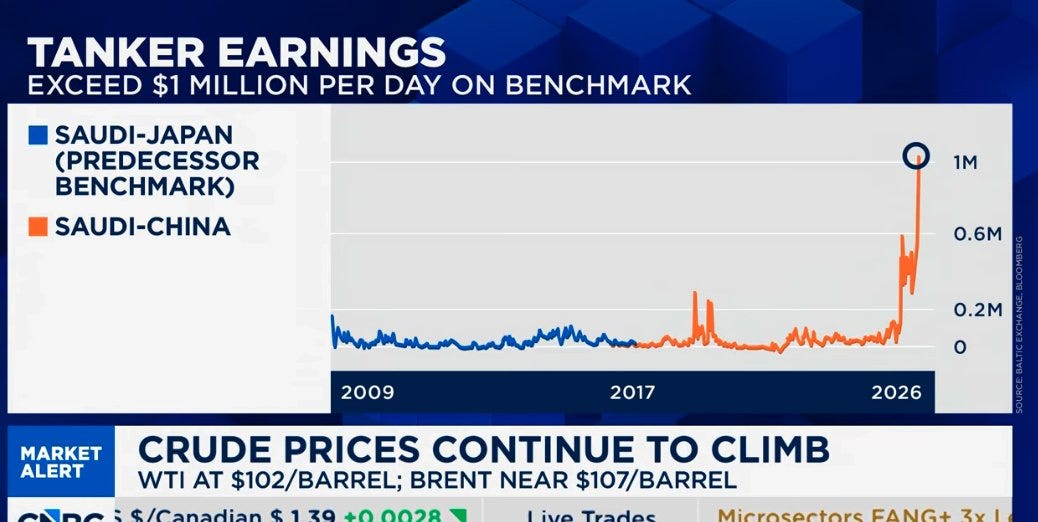
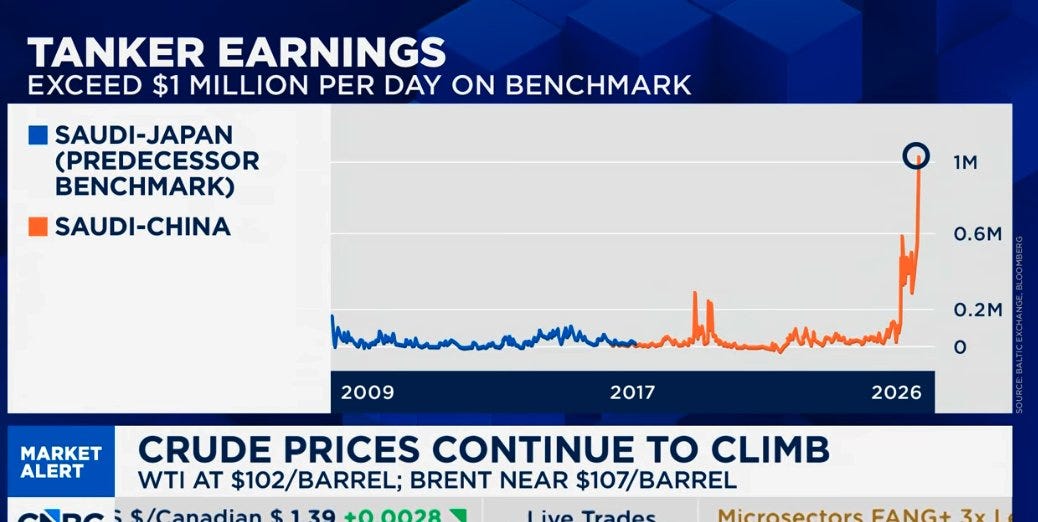
The Iran war is expanding, as the Houthis attack Saudi infrastructure. That’s very bad. And there’s a shortage of oil tankers, which is pushing up costs and earnings of the steamship lines. Oh, and 10 year bond yields are above 5%.
New Democratic ‘it girl’ Jon Ossoff is leading in the 2028 primary vibe race, he just got a $1 million donation from Epstein-linked tech oligarch Reid Hoffman, who is best-known for calling for Lina Khan to be fired by Kamala Harris if she became President.
The Chinese are cutting rare earth exports to the U.S. just before a major Trump-Xi summit, in order to create leverage against America.
DraftKings built a machine learning model to market explicitly to gambling addicts.
Mark Carney is heroically standing up to Trump by privatizing Canadian airports
Senators Adam Schiff and Jim Banks nearly got an antitrust exemption for AI in the defense bill. Since that bill is being debated, it may still be in there.
And relatedly, there is what looks like a bad faith operation to get Congress to include such an exemption. It comes in the form of a possibly frivolous antitrust case against OpenAI, Anthropic, and Google for slowing down development of the technology, brought by some elite lawyer with no antitrust experience. The plaintiff is a dark money funded political operative named Cheyenne Hunt, who helped organize the campaign to destroy Graham Platner.
They are arguing that any collective attempt to make the technology safe is illegal, which of course isn’t true. The argument is terrible, and it’ll be tossed by a judge, but the goal is likely to pretend that creating safe products is a violation of antitrust law before it is heard in court, in the hopes that Congress will give special dispensation to this industry sector out of fear.
When we argue that doing things safely is already legal, there will be a lot of “well how come there’s an antitrust case?!?” The answer is because it’s legal to sue anyone for any reason, but that doesn’t mean anything except you got a lawyer to file a piece of paper.The Trump-Vance Federal Trade Commission settled a case against Amway originally brought by Lina Khan. Chair Andrew Ferguson called it a “landmark” settlement, Amway did not. “Amway has not admitted any wrongdoing or liability. The Amway spokesperson said the settlement ‘reaffirms’ the strength of Amway’s business model.”
The Trump FAA is deploying AI to do air traffic controlling at DC airports.
The antitrust old guard, Bill Baer and Tom Wheeler, point out that antitrust as it currently exists just doesn’t deliver competitive markets.
Really ugly hospital merger in North Carolina, WakeMed-Atrium.
Apple is asking for the Supreme Court to toss the contempt order it got when it refused to obey the consent decree imposed by a district court over its unfair app store policies vis-a-vis Epic Games.
Trump’s Treasury Secretary met with his Chinese counterpart, and it looks like lower tariffs on Chinese consumer electronics are coming.
Associate Attorney General Stanley Woodward says AI companies can seek business letter review for planned AI coordination.
The Trump administration could have brought criminal charges against Abbott Labs over poisoned baby formula, but opted for a parking ticket instead.
Compass is gaining more power in real estate listings, and its rival Zillow just lost a major antitrust case that would have allowed it to stop Compass from consolidating the market.
Commerce Secretary Howard Lutnick’s wealth has doubled since he joined the Trump administration, largely because of his crypto holdings.
There’s an aggressive campaign to get rid of antitrust laws at this point. The “dean of the antitrust bar” Herb Hovenkamp is constantly agitating to remove the merger guidelines, the FTC is creating bad precedent on price discrimination, Congress is punching a hole through antitrust for the NCAA, and here’s a top Republican Judiciary member Scott Fitzgerald arguing that states shouldn’t be able to challenge mergers.
The FDIC is creating new policy to rush through bank mergers, creating a “rapid processing” framework.
The Trump-Vance FTC has created a new process to make it easier for big business get rid of consumer protection rules.
Another day, another silly argument in The Argument about how big business is good.
Rocket Lab is closing on its Iridium acquisition as the space sector continues to consolidate.
Qualcomm closed its acquisition of Modular.
OpenAI showed six more incidents of unsafe behavior by their most advanced model. Uh, guys, don’t release dangerous products.
“Pfas companies are launching a “tidal wave” of forever chemicals production to meet demand from the AI industry, a campaign organisation has warned.” Not great!
Barack Obama continues his gross post-Presidency, in this case praising his former press secretary Jay Carney for becoming a lobbyist who wants to “rebuild bonds between leaders in the artificial intelligence sector and Democrats.” Just an open endorsement of oligarchy and corruption, to the cheers of the Democratic establishment.