“When did it start? Since when did animation stop being interesting? That is, animation itself may have stopped being interesting, and I myself may have been unable to maintain interest in animation. Both may be true. Animation may be over.”
Hideaki Anno wrote these words in 1993, just two years before he would definitively disprove them with the creation of his magnum opus, Neon Genesis Evangelion (1995–6). His pessimism was not without cause: the anime industry was in a slump, even before the bursting of Japan’s “bubble economy” in 1992 lead to major contractions. In particular, the science-fiction and mecha (a.k.a. “giant robot”) genres that had forged Anno’s own fandom, and on which he’d cut his professional teeth, had mostly disappeared from the airwaves and migrated to the home-video market. Anno and his studio Gainax had broken it big there with his first directorial project, the 1988 miniseries Gunbuster—an eccentric mash-up of giant robots, sports anime, hard sci-fi, and the then-recent Tom Cruise blockbuster Top Gun—but had hit much harder resistance on television. His first TV series, Nadia: The Secret of Blue Water (1990–1), suffered an arduous production, and left Gainax with major financial losses. Anno found himself emotionally in step with the medium he loved—which is to say, he spent the early nineties in a period of severe depression.
Produced in the wake of this personal and professional malaise, Evangelion proved both an emotional exorcism and a huge commercial paradigm shift. Its twenty-six-episode run sparked a new boom in anime production, fandom, storytelling, and merchandising that carried into the twenty-first century. It popularized the late-night anime block—where shows were broadcast in inexpensive time slots late at night or in early morning hours, creating a haven for more experimental and adult-oriented series—while further intensifying the already-hot home video market. And that was all before Evangelion left Japan: the series was also a crucial leader in establishing a durably popular anime market in the United States and other English-speaking territories. In the nineties, anime in America largely existed either as an underground, bootlegged subculture or through dubbed “cartoons” on TV edited to disguise their “foreign” nature. Evangelion’s release on both dubbed and subtitled VHS, beginning only months after the end of the Japanese broadcast and without content edits, refused this binary, and its popularity proselytized anime to a new generation of fans. (This dub, beloved by English-speaking fans but out of circulation since a new version was recorded in 2019, is the option presented on the Criterion Channel, alongside the original Japanese, restoring official access to an important piece of anime history).
In the case of a more sober and conventional series, this is the point at which I would introduce the plot. I would describe the then-future setting of 2015, fifteen years after a cataclysm known as the “second impact” decimated human civilization; and I would explain how and why the race of giant, Lovecraftian monsters known as Angels can only be stopped by the intervention of biomechanical mechas called Evangelions, which must be piloted by emotionally unstable teenagers speed-running their way through every psychological roadblock known to Freudian psychoanalysis. But the plot, lore, and logic of Evangelion is a Pandora’s box even Evangelion itself is hesitant to fully unseal, especially in its increasingly experimental second half, which ultimately jettisons narrative coherence in favor of thematic resolution. To experience Evangelion is to be confused by Evangelion, and to be confused by Evangelion is part of the pleasure of Evangelion.
One will quickly realize that what matters most are the minds and hearts of its vivid, complicated characters, principally the teenage protagonist Shinji Ikari, a vessel for Anno’s own depression, self-loathing, and indecision. While the opening episodes—in which Shinji is pressured to pilot the eponymous Evangelion at the behest of his simultaneously domineering and absentee father, Gendo—are full of bombast and spectacle, Evangelion declares its true intentions in its fourth episode. This half-hour features no robots, no monsters, no action or external threat of any kind, instead offering a startlingly intimate portrait of depression as Shinji withdraws into himself while receding further and further from civilization. Although the series excels in sequences of kinetic action, it here establishes its equally potent penchant for slowness, for compositions filled with negative space, and for confrontationally long takes—in sum, a devotion to sitting with emotional discomfort, and using the hollow stillness of an exterior landscape to express the desolation of a person’s interiority.
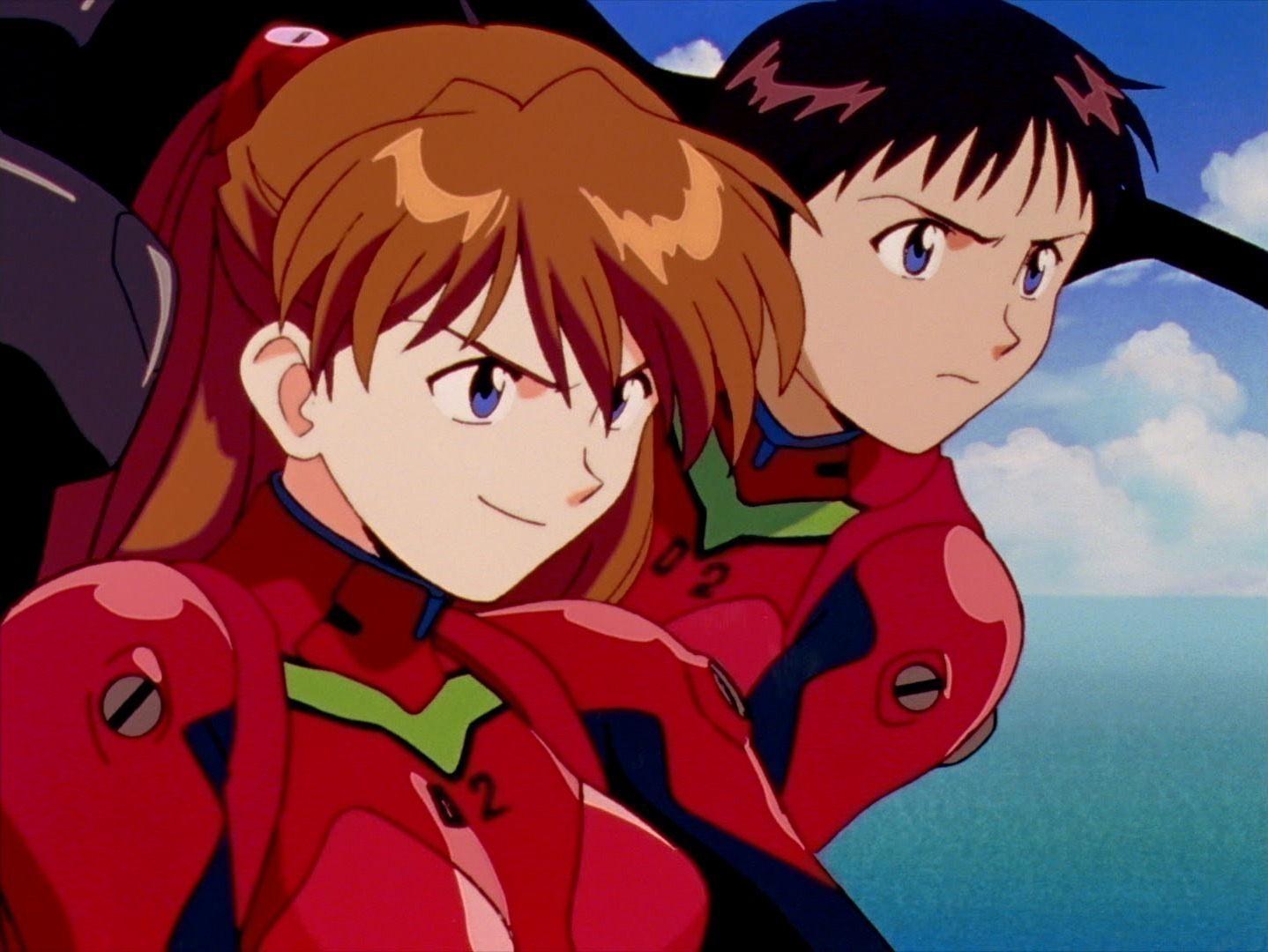
Indeed, the true artistic legacy of Neon Genesis Evangelion isn’t as a feat of world-building or narrative, but as the work that fully inaugurates anime’s postmodern moment of looking inward. Inward to anime’s own history, own subcultures, and own aesthetics; inward to the material essence of animation itself, as Evangelion’s later episodes and feature-film follow-ups play with rough sketches, unfinished animation, and other preproduction material, using such imagery as an expressive metaphor for escaping from narcissistic self-withdrawal and developing a healthy ego; and inward, most of all, because the series identifies its core battlefield not as the land upon which the monsters and robots fight, but the space within the mind of its emotionally insulated protagonist, which by the end of the television series comes to wholly overtake the external diegesis.
The series’ creators were all dyed-in-the-wool anime fans whose influences and tastes were forged not only by the shows they grew up on, but by the well-developed fan culture surrounding the industry. Among their key touchstones was Mobile Suit Gundam (1979–80), which had shifted the course of mecha anime with its focus on in-depth character psychology, scientific plausibility, and detailed world building. Shinji himself is a clear descendent of Gundam’s protagonist Amuro Ray, moodier and more introverted than the nekketsu “hot-blooded” young boy character type found in earlier “super robot” anime.
Here, Anno identified a place where his own depressive tendencies and thematic interests mapped onto a durable archetype. But if other boys had refused to “get in the robot” before Shinji Ikari, few did so with the sheer degree of despondency and diffidence as he, and few works prioritized that study of depression and interiority above all else. The innovation of Evangelion lay not in rejecting or deconstructing the last fifteen years of anime, but in refining and pushing these ideas even further. In Japan, the series is known as the progenitor of the sekai-kei (“world type”) anime, stories in which the personal crisis of an individual or romantic pair is mirrored in an apocalyptic danger of global proportions. If you’ve ever seen a film by Makoto Shinkai—Your Name, Weathering with You, and Suzume are among the most popular animated films of the twenty-first century—you’ve seen a sekai-kei narrative, one marked by the influence of Evangelion’s emotionally maximalist storytelling.
Evangelion should also be understood as a descendent of the live-action tokusatsu series—special effects–driven sci-fi/fantasy shows depicting mankind’s battles with giant kaiju invaders—that emerged in the 1960s. Anno is particularly indebted to Tsuburaya Productions’ Ultraman, from which Evangelion inherits three fundamental characteristics: First is the series’ setup, in which a secretive UN-chartered organization, usually boasting a three or four-letter name, leads the fight against giant monsters (the original Ultraman has the SSSP, while Evangelion has NERV). Second is its copious Christian imagery. Creator Eiji Tsuburaya’s devout Catholicism made this a fixture of Ultraman, where the eponymous hero—a being from the “Land of Light” who walks among humanity by taking the form of a man—is an obvious Christ allegory. Anno doesn’t deploy spiritual iconography to such theologically coherent ends, instead mixing crosses, stigmata, and spears with other pieces of Judeo-Christian mysticism (the Dead Sea Scrolls) and Japanese Shinto cosmology (the vision of a “primordial cosmos”) to create a mythology that is highly evocative without cleanly mapping onto real-world faith traditions. Third is the extreme visual style pioneered by Ultraman’s greatest director, Akio Jissoji, whose episodes are filled to the brim with shots of such conceptual and practical complexity that each would be the standout image in any other production. His contributions to Ultraman (1966–7) and Ultraseven (1967–8) are the greatest formal influence on Anno’s style from Evangelion to the present day, obvious whenever characters are framed through a prism, reflected in a mirror or pair of sunglasses, or accompanied by compositions from the canon of classical music. These influences run so deep that, when interviewed for this year’s The Origin of Ultraman documentary, Anno stated, with an air of artistic resignation, that “the curse of Ultraman will last until I die.”
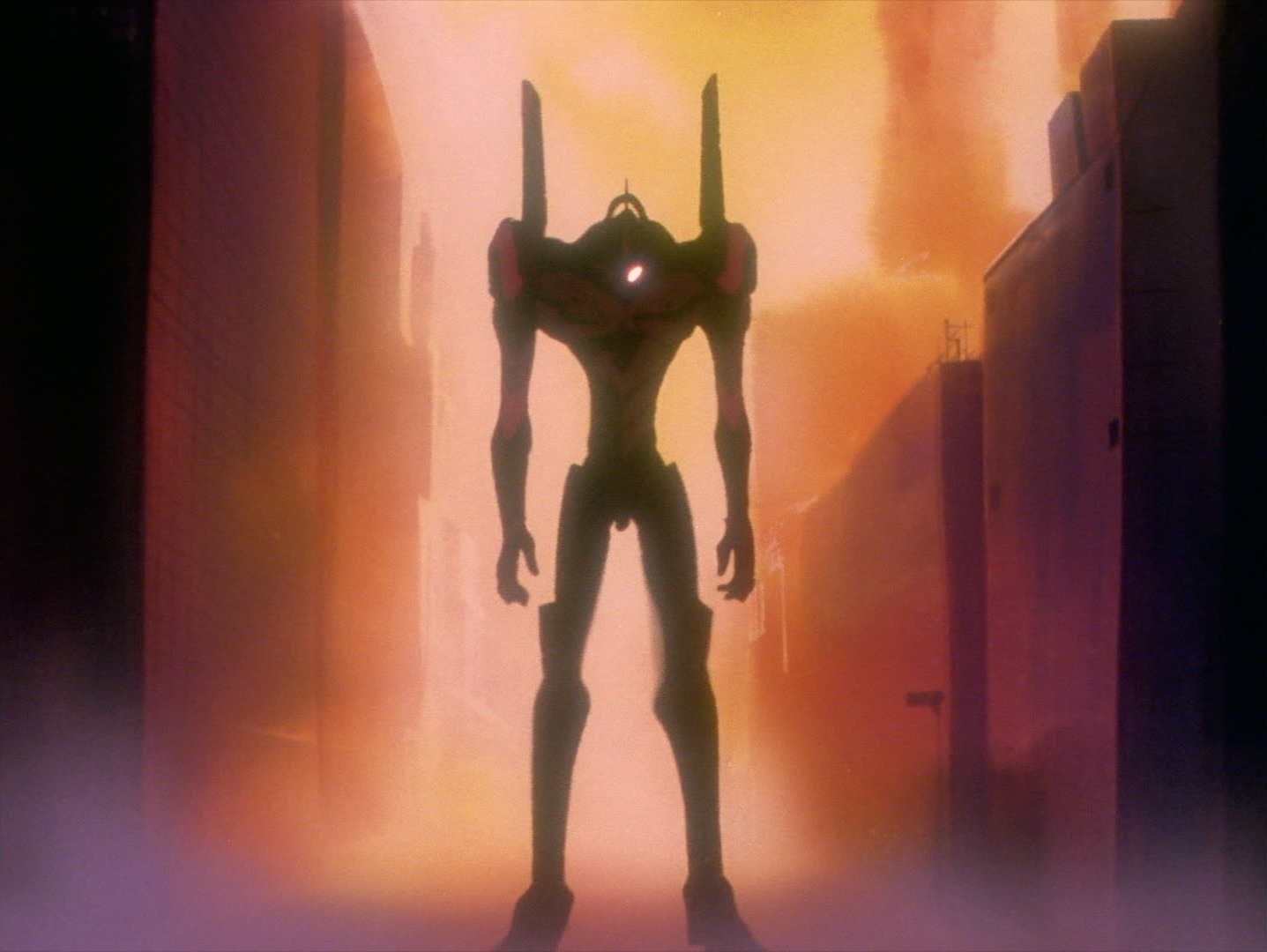
As this rich mélange of influences attests, Evangelion was a product of true otaku, the Japanese word for hardcore fans of anime and related pop culture (and which, in Japan, carries a much more ambivalent connotation than its more neutrally descriptive English usage, thanks to high-profile cases of violence, withdrawal, and other antisocial behavior in the eighties and nineties associated in the public consciousness with anime fandom). Anno’s professional life was intertwined with his fandom from the very beginning. Although accepted to the prestigious Osaka University of Arts, he was expelled after three years. Instead of attending classes or paying tuition, he’d been making connections with other anime fans turned artists, who banded together to create a pair of short films for the Daicon III and IV sci-fi conventions in 1981 and 1983. Gleeful mash-ups of copyrighted characters and songs animated with a delirious sense of style, these shorts got Anno and company’s foot in the door in the industry and led to the formation of Gainax in 1984 (the same year Hayao Miyazaki’s epochal Nausicaä of the Valley of the Wind was released, itself featuring animation by Anno). The artists who would serve as Evangelion’s creative leads assembled at Gainax over the next few years, including assistant directors Kazuya Tsurumaki and Masayuki, character designer Yoshiyuki Sadamoto, mechanical designer Ikuto Yamashita, cowriter and storyboard contributor Shinji Higuchi, and composer Shiro Sagisu. All were born within less than a decade of one another, and were in their late twenties to midthirties at the time of Evangelion’s production, placing them at the forefront of a new creative generation: one that had never known a time before mecha anime, tokusatsu shows, or the fan cultures they inspired.
Yet as was often the case at Gainax, budgetary mismanagement and creative indecision plagued the production down the home stretch. The final two episodes of Evangelion are infamous, as they fully abandon all narrative momentum and giant-robot action in favor of a decidedly avant-garde approach attending squarely to Shinji’s bruised psyche. Closer to the latter-day essay films of Jean-Luc Godard than any other mecha anime half-hours, these episodes depict a dense, verbally aggressive, but visually ascetic Socratic dialogue with the self, a sort of personal interrogation illustrated through a combination of reused footage, sparse and simple new animation, on-screen text, and unfinished drawings and production materials. Although they provide a thoughtful and powerful thematic closure to the ideas undergirding the series, their near-total abandonment of the show’s plot, mythology, and exterior stakes understandably baffled and upset contemporary fans, leading to calls for a do-over. The series’ immense commercial success enabled Anno and Gainax to do just that, in the form of two feature films.
The first, Evangelion Death (True)², is a compilation film re-editing the first twenty-four episodes of the TV series. Although relatively unfamiliar to American audiences, compilation films have been a common practice in Japanese cinema for decades. They provide an opportunity for fans to catch up on the story while seeing their favorite scenes play out on the big screen, and give animators a chance to touch up or replace certain shots, or even create all-new scenes that weren’t a part of the TV broadcast. Death (True)² fulfills each of these functions, but is also unusually bold in style and rigorous in structure for this kind of film. Presented not as a chronological plot recap but a series of thematic movements, the film is structured around the motif of Shinji and the other Evangelion pilots rehearsing in a string quartet for a performance of Pachelbel’s Canon, with aggressive, free-associative editing layering events from across the series on top of one another, accompanied by quick, staccato text inserts, often of just a few frames. The result is a dynamic and provocative viewing experience worth the time of even those who know the series by heart.
This film was first released to theaters in March 1997 as part of Neon Genesis Evangelion: Death & Rebirth, where it was followed by twenty-five minutes of all-new animation—announced, at the end of the presentation, as an extended preview of the second film, Neon Genesis Evangelion: The End of Evangelion. Released in full that July, this ninety-minute feature presents an alternate version of the series’ last two episodes. Where the original ending was sparse, still, highly interior, and ultimately quite optimistic in its vision of Shinji’s emotional rehabilitation, the version found in The End of Evangelion is almost the exact opposite: a spectacular, bombastic kaleidoscope of violence and kineticism, its animation overwhelming in scale and speed, its tone bleak and its imagery grotesque. Different as they are, these two disparate endings are connected by their penchant for avant-garde experimentation, with the feature’s rapid frame-by-frame edits recalling the experimental animations of Stan Brakhage, and a live-action interlude musing on the nature of anime fandom playing once again in the essayistic tone of Godard or Chris Marker. Both versions also share a common thematic arc, in which the “end of Evangelion” means rejecting Evangelion as a tripartite signifier: the in-universe mechs, the series and story they exist within, and the insular world of anime fandom itself. As indelibly touched by fandom as the series is, Evangelion ultimately reflects the ambivalence the word otaku occupies in Japanese culture, making the series both a product of and manifesto against the insularity of fandom.
That said, this would not, in fact, be the end of Evangelion, as Anno and much of the original crew revisited their seminal work with the four-part Rebuild of Evangelion film series from 2007 to 2021. Far more than a straightforward remake, these features begin from a shared narrative foundation with the TV series before striking out in an entirely different direction, providing the creators a chance to reflect on a story born from youthful passion with the prudence and insight of age and experience. They are among the great achievements of global animation in the twenty-first century.
But whichever the telling, Evangelion in all its forms is a work worth watching for the strong reactions it prompts. Love it, hate it, or simply walk away baffled, one will be marked by the encounter. I myself confess to having a tenuously passionate relationship to the original series and The End of Evangelion, vacillating between intense identification with its raw, deeply felt depiction of depression, awe at the most daring and virtuosic stretches of animation and direction, and feeling some alienation toward the show’s “fan service” imagery and generally schizophrenic depiction of women. But I love the Rebuild tetralogy profoundly, and that love only exists in the context of the broader conversation with the original work those films both practice and encourage. Whether one is a seasoned anime veteran or a relative newcomer to the world of Japanese animation, Neon Genesis Evangelion is a must-watch: a series worth experiencing and grappling with, in no small part for what it may teach you about yourself. Despite Anno’s anxieties of the early nineties, animation is far from over, and Evangelion is an exemplar of the relentless passion, innovation, and never-ending dialogue between creator and audience that has kept anime alive and at the forefront of global pop culture for so many years.
Thanks to Sean Chapman for the translation at the top of this piece.