For about a year, BIG has been involved in a fight over a merger between Paramount and Warner Bros Discovery, a $110 billion deal in which the Trump-friendly Ellison family has attempted to buy up much of news media, movie, and the television industry.
Today they won, and we lost, as the key political leaders opposing the deal, California Attorney General Rob Bonta plus eleven other state law enforcement chiefs, allowed the merger to go through, conditioned on certain promises that I’ll get into, most notably more investment in movie-making and editorial independence for news channels. There are a bunch of reasons they cleared the deal, such as threats to move the studio out of California, corruption, and general incompetence. But first, let’s go through this deal, such as it is.
What were the promises? The full details are in the consent decree, though it’s notable that it’s basically impossible to enforce, since it essentially requires state attorneys general to bring the case they are unwilling to bring now, when they have maximum leverage.
But it’s worth going over the commitments regardless. The number one supposed obligation is that Paramount-Warner will make 30 films a year for two years, then 32 films a year for the following years. That is meat to look like an increase. But as former FTC Commissioner Alvaro Bedoya notes, when you look at the fine print, they only have to distribute that many films, they can make half as many. And those can be co-produced. So in fact, if you add up the numbers, Ellison promised to make fewer films going forward than Paramount and Warner are putting out today.
There are also commitments for investment in domestic filmmaking of $300 million, which ratchets up if California and the United States offer tax credits for movie and TV production. And Paramount-Warner can’t sell the Paramount studio lot or Warner studio lot for as long as the agreement lasts, which is five years. Amusingly, there’s not a commitment for Warner-Paramount to remain headquartered in Los Angeles, so Ellison could simply move it out of LA if he wants. I don’t think he will, that threat was never real in my view. But if it were a real threat, Bonta didn’t mitigate it.
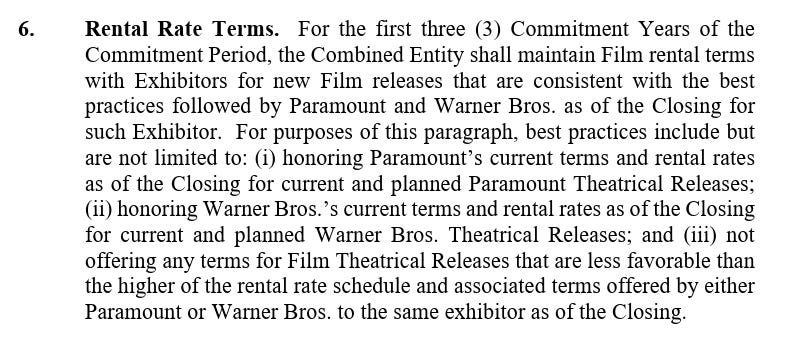
The combined company is also agreeing to maintain its existing rental terms with theater chains for just three years. After that, they can ratchet up prices.
Then, there’s an editorial board overseeing CNN and CBS, which Connecticut Attorney General William Tong and Bonta bragged about. Except all of the people on that board are appointed by the board of Paramount-Warner, aka David Ellison. Here’s that provision":
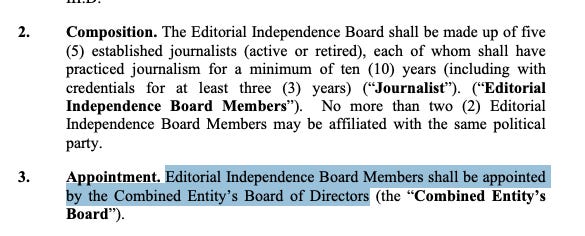
I personally think CNN is terrible, and I’m glad it’s going to be discredited. I also find it embarrassing that the Democratic AGs used antitrust law in an attempt to shade news coverage. But it’s downright comical they demanded that David Ellison not corrupt CNN by having David Ellison appoint a board ensuring that David Ellison not do that.
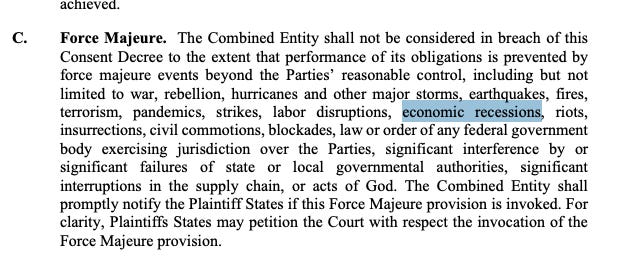
Finally, and I think this one’s the cherry on top, there’s a provision that makes the whole thing almost entirely worthless. It’s called the “Force Majeure” provision, and it lays out the conditions that void the agreement if there are events beyond the control of Warner-Paramount. These are usually things like earthquakes, war, riots, and so forth. But in this case, they included “economic recessions,” plus strikes and labor disruptions. Yes, if there’s a recession, which is likely if the AI bubble pops, all of these promises are no longer enforceable. Or if Paramount-Warner decides to stop paying actors, and there’s a strike or actors don’t show up, yup, the agreement is void. Keep in mind, this agreement has 12 signatures from state attorneys general, who presumably had someone read and agree to this garbage.
There are a few more minor elements. The state AGs will get their case costs reimbursed, which amounts to $40 million. Some of the unions will get some health care costs taken care of, plus some fig leaf promises on layoffs. And there’s an anti-retaliation provision, and some promises to spend a token amount on ‘independent’ movies.
The Writer’s Guild had no choice but to cave, they were isolated and did not have tens of millions to pursue this case.
The key villains here are Bonta and California Governor Gavin Newsom. Bonta, for months, stood tall, pretending to be a tough enforcer. He called this whole thing a meat-and-potatoes antitrust case, made arguments that he would only accept structural changes to the deal, aka spinoffs of businesses not vague promises, said the case was not about CNN, plus barked at what he called blackmail as Paramount threatened to move to Tennessee. Today, he accepted vague promises, said this deal was great for California, bragged about oversight of CNN, and made zero attempt to explain his complete flip-flop. Newsom, along with most of the establishment California Democratic Party, had lobbied Bonta to drop the suit, as did the Director’s Guild and International Alliance of Theatrical Stage Employees (IATSE).
It’s especially hilarious they made this decision the same day that Trump blocked CNN from the White House, leading to all sorts of rhetoric about the importance of corporate media. Here’s Newsom, in a deeply cynical statement trying to deflect from what he just did.
And that is so even as David Ellison gave a shout-out to Newsom for his “support throughout the process.”
So what does this whole collapse mean? Well, I’m in a strangely good mood. This acquisition, while certain to damage Hollywood and the media, required immense amounts of political capital to get through.
Consider what it took: An aggressive President, a right-wing Congress, a deeply morose California Democratic establishment, California Governor Gavin Newsom and NJ Governor Mikie Sherrill, LA Mayor Karen Bass, stars like Tom Cruise and James Cameron, major movie theater chains like AMC, Regal, and Cinemark, unions like IATSE and the Director’s Guild, JP Morgan’s CEO Jamie Dimon, much of Wall Street, every global antitrust enforcer, plus a highly dishonest and corrupt press all had to put their thumb on the scale to beat what was essentially a group of frustrated artists led by Mark Ruffalo, the Writer’s Guild, some outraged antitrust lawyers, and a surly public.
They had to lie, cheat, and steal. And they did. That is not strength, it is weakness. It is very different than earlier mergers, like Disney-Fox, that went through without any meaningful opposition. In this case, everyone saw the deal could have been blocked, a judge had already ruled multiple times that the case was reasonable, and Bonta just flip-flopped. When the Paramount-Warner deal turns out badly, and it probably will, everyone will know who to blame.
Still, there’s an interesting outstanding question. Why would Bonta betray us so openly? There is a lot of speculation on that question. Was there bribery? Blackmail? Legal threats? I think the answer is more basic. Bonta simply felt left out and excluded from the rest of the Democratic insiders. But now, after the settlement became public, the reaction is one of raw, unadulterated rage. There’s no “well I can see both sides here,” it’s just a cut-and-dried recognition of betrayal.
And perhaps that’s why I don’t feel any sense of despair. Obvious symbols like this don’t happen very often, usually it’s blurry, the public is confused. But not anymore. Instead, this time the insiders are confused. I’ve been in and around Democratic politics for more than twenty years at this point, and I know many people like Bonta and Newsom. They lack intellectual or moral confidence, their goal is to please powerful people around them, and they are indifferent to the real world. They are teacher’s pets, and they never grow out of it.
I’m reminded of a conversation I once had with a legal scholar named Cass Sunstein, who is a widely cited and politically influential ex-Obama administration official. I met him at a book event for his now-discredited book Nudge and criticized his thesis. He didn’t defend himself, but instead listened and made my argument for me. It was weird, and then I realized, he was simply trying to make me like him. To him, being correct or not, or holding any sense of integrity, was utterly irrelevant. He simply didn’t want to offend anyone.
That’s what this culture is about, it’s completely vacuous courtier politics, people living as if they are seeking the favor of a monarch instead the honor of popular support. And that’s why this merger loss is useful. It shows that Trumpism isn’t about one man, and it’s not about a nation full of racist voters or anything like that. Democrats like Gavin Newsom and Rob Bonta did exactly what Trump did, on behalf of the same oligarchs, because their basic view of power is the same. They simply cannot fathom a world in which we have equality before the law.
But that is the old era. Those people were elected years ago, and the public wants something very different now. Americans don’t trust our institutions or our leaders, and that’s the right attitude, because our institutions and our leaders are malevolent liars. Fortunately, we have the honor of living in a democracy, which means the voters have the ability to fire their leaders. And that is about to start, in a big way.
So happy oligarch day. I have a sneaking suspicion that this loss doesn’t suggest the collapse of a democratic order, as that collapse happened a long time ago. I think it may actually represent one of many death rattles of an old order that Americans correctly despise.
Thanks for reading! Your tips make this newsletter what it is, so please send tips on weird monopolies, stories I’ve missed, or other thoughts. And if you liked this issue of BIG, you can sign up here for more issues, a newsletter on how to restore fair commerce, innovation, and democracy. Consider becoming a paying subscriber to support this work, or if you are a paying subscriber, giving a gift subscription to a friend, colleague, or family member. If you really liked it, read my book, Goliath: The 100-Year War Between Monopoly Power and Democracy.
cheers,
Matt Stoller