Before getting to the full round-up, I want to make an announcement. I am going on paternity leave, and handing over the site to Lee Hepner, an antitrust lawyer and a colleague of mine who has written for BIG many times. Lee is brilliant and an expert on surveillance pricing. He also has a lot of experience in California politics. This will be my last round-up essay for awhile, but you are in good hands as we head into an election season.
Ok, this past week was a doozy. On the good news front, the polling for the midterms looks better and better for Team Anti-Monopoly. On the bad news front, well, everything else. The new comically corrupt Antitrust chief, Adam Candeub, was advanced out of the Judiciary Committee and Apple is sending its app store antitrust case to the Supreme Court for the third time.
The most important news is that Paramount and Warner Bros. overcame the key hurdle to closing their deal, when California Attorney General Rob Bonta and 11 Democratic state attorneys general dropped their opposition, which I discussed on Monday in detail. It isn’t quite done, the judge hasn’t agreed to approve the consent decree, and there are amicus briefs and a well-received letter from Senator Cory Booker that the judge will hear arguments about. But it’s hard to imagine this one being paused for legal reasons.
It’s easy to see this merger fight as a catastrophic loss, which it is. It will combine two of the five major movie studios, CNN and CBS, and major streaming platforms under the control of a highly politically connected owner of Oracle and TikTok. Iconic TV writer Mike Schur basically said it’s game over for Hollywood, and the American news media will likely become more corrupt, feckless, and aligned with capital.
But the merger challenge is also more than that, and it has implications beyond the castle walls of media, as important as those are. This fight was a battle between coalitions, and in some ways, it is a prelude to more of that fight in this election cycle and beyond.
David Ellison, son of Oracle billionaire Larry Ellison, wasn’t alone in his empire-building ambitions. It takes a village to centralize media. Wall Street was fully on board, as was the defense bar. In August, JP Morgan CEO Jamie Dimon said that the state challenge to the Paramount-Warner merger has the potential to “deeply damage our capital markets, our dynamic system.” Donald Trump pushed the deal, but so did Democrat Ari Emanuel, brother of Rahm Emanuel. So did Tom Cruise. So did the Director’s Guild and the International Alliance of Theatrical Stage Employees. So did California Governor Gavin Newsom, LA Mayor Karen Bass, incoming Governor Xavier Becerra, and much of the state legislature.
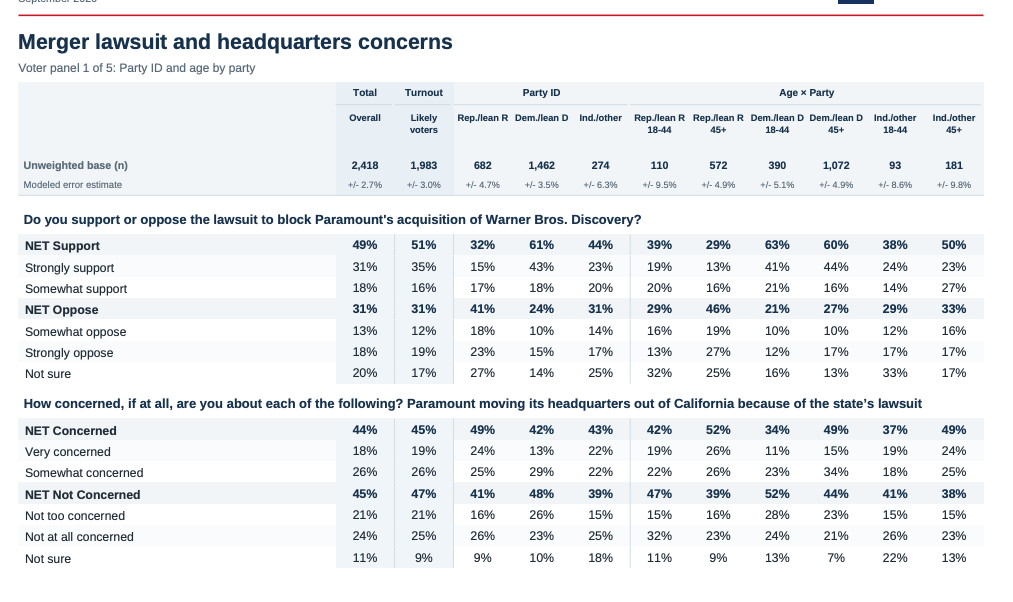
The other group were populists on the left, the anti-monopoly world, artists, the Writer’s Guild of America East and West, and the public itself. What they lacked in money and organization they made up for in grassroots support. Most voters do not think the deal will be good, and Californians supported challenging the merger 49-30. This fight was a line in the sand for the masters of the universe, who have been fighting against a pushback on AI data centers, and a billionaire tax, and before that, Lina Khan’s attempt to revive antitrust law.
We learned two important things in this battle. The first is what happens when an elected leader tries to say no to an oligarch after 45 years of unfettered rule by capital. That is, they get extremely angry and vicious. As G.K. Chesterton once said, “The poor have sometimes objected to being governed badly; the rich have always objected to being governed at all.”
Ellison threatened the entire state of California with moving Paramount out of the state, his legal team said they’d destroy antitrust law by appealing to a Supreme Court whose members they know personally, his allies controlled most of the media narrative about the case, and he engaged in an extreme version of corruption vis-a-vis the President.
What does that mean going forward? Well, if the Democrats do win, and they do try to impose even modest limits on capital, then they will face the same level of pushback. If they, say, try to stop health conglomerates from denying needed care, health insurers will simply say, in one way or another, ‘well if you do that we’ll be forced to kill a bunch of people.’ If they try to cap hospital CEO salaries, it’ll be, ‘too bad the poor have nowhere to give birth now.’ If they attempt any limits on defense contractors, well, ‘sucks that U.S. soldiers won’t have the parts they need to detect incoming missiles.’ If they try to subject big tech CEOs to the rule of law, it’ll be ‘too bad those rogue AI systems are gonna be a little more rogue.’ And so on and so forth.
Oligarchs will have massively well-funded legal teams explaining why all of that is not only legal but absolutely necessary, and they will file in districts in Texas or Mississippi where they will find favorable judges to take their side. At every moment, the press will adopt a ‘both sides’ attitude, making it extremely hard to tell a story about what they are trying to do.
The second level is about the Democrats, which is a political party few people really understand. The most important thing to get about the older generation of Democrats is they are fundamentally uninterested in the real world. They have a form of politics, but it is unrelated to governing. It is about validating each other as savvy and polite, while deferring to objective experts. That’s why they love ‘independent’ agencies and asking for studies and vague regulations.
And that’s why this merger challenge was so important.
When California Attorney General Rob Bonta took a stand against this merger, it was stark, a real position on an important question of market and media structure. He was playing in the big leagues, where Wall Street plays. When he reversed himself completely on this merger, he met widespread disbelief from virtually everyone, from opponents of the deal to supporters of it. And that’s not because he caved, but because he had talked so tough and then flipped without any explanation. There were many people musing about whether he had been blackmailed, or bribed, and whether this move was the biggest betrayal anyone had ever seen.
But I don’t think any of those are why he flipped. I think he flipped because he assumed no one would care. And that’s because all of the insiders around him likely told him serious people would let this merger through, and any controversy would blow over in a few days. The entire state Democratic establishment was pressing him to let the merger through, and he doesn’t notice anyone but them.
Think about it differently: Bonta could have simply said, ‘well I’m not willing to risk the economic viability of Los Angeles and the Federal government needs to step in,’ or any other number of excuses. That would have split the opposition and rescued his reputation. But he didn’t. He just let the deal through, then insisted he cured the market power, which was comically embarrassing. It was just weird to see such a brazenly dishonest loser.
What most don’t realize is what was unusual about this situation, and it wasn’t the betrayal itself. Most Democrats do this kind of reversal, and have for many decades. A famous quote from former New York Governor Mario Cuomo, who was once revered as a liberal icon in the 1980s, was, ‘You campaign in poetry and govern in prose.’ While beautifully phrased, that is simply a naked and cynical argument for lying. That is just how neoliberal Democrats operate. The only thing they care about is what other insiders think of them as they run empty campaigns and sit in plush offices. It’s a form of courtier politics, where understanding the real world is irrelevant, and what matters is how the insiders perceive you at court. So Bonta didn’t need to be bribed, or cajoled. He was just doing what Democrats elected prior to 2024 do.
Most neoliberal Democrats are like actors playing doctors on TV. Asking a neoliberal Democrat to do something about corporate power or economics is like asking a TV doctor to do surgery. It’s not just that they won’t do it, they are baffled anyone would even consider that their job. A different analogy is the film Galaxy Quest, a sci fi adventure about a group of actors from a Star Trek style show. They are pulled into a battle among aliens, one faction of whom thinks the show is a documentary of a real civilization and has built their society around the fictional series. At a certain point, the lead has to tell the aliens who have worshiped him that he is in fact just an actor.
What Bonta did here is just that.
In other words, it wasn’t the betrayal that was unique, it was that everyone noticed it. Barack Obama ran on fixing the foreclosure crisis and talking tough on Wall Street, he even beat Hillary Clinton in Iowa by promising antitrust action against meatpackers and Monsanto. Then he did the opposite, which was a much bigger reversal than Bonta’s. Don’t take my word for it, Reed Hundt, the insider who introduced Hillary Clinton and Barack Obama, wrote the definitive account in A Crisis Wasted.
The difference between Bonta and Obama is that Obama was able to persuade Democrats that he was doing the best he could, and so most of them thought, ‘well, he tried, that’s just capitalism/racism/America.’ As a result, it was impossible to build a coherent left politics on populism for ten years. And even now, large factions imagine that there’s a structural explanation but cannot fathom what actually happened, which was a set of choices by Obama. But years ago, Democrats realized they had to actually explain themselves when they betrayed. They had to lie. Now the blood has gone thin in these last generations of neoliberalism. These guys are dumb club members. So with Bonta, it was just a straightforward and obvious lie, this time in the spotlight.
Now, I’ve been careful to say that it’s an older generation of Democrats who cosplay as substantive. One reason Lina Khan has a different valence is because, to continue the analogy, she isn’t an actor playing a doctor. She’s a surgeon, and it was shocking, confusing, exhilarating, and scary all at once to see someone in policy actually playing with the big boys in a real way.
This cycle is going to see a bunch of new people elected. Last year is when New York Mayor Zohran Mamdani won, and he definitely is perceived to have a different approach. How different is an important question. Abdul El-Sayed, who is probably the most important figure, is quite smart. We interviewed him for Organized Money. Melat Kiros and Angie Nixon both prevailed on campaigns that promised to break up big medicine and take on corporate concentration. So did Aisha Wahab in California. In Arkansas, Hallie Shoffner is campaigning against corporate concentration of farming. There will be more of this.
They may show a different form of politics, taking the side of the anti-Ellison coalition, as it were. The point, though, is that what we just saw is not just a battle we lost. It is a prelude of the kind of tactics and coalitions to come. Right now, it’s clear that billionaires don’t have to follow the law. It’s also clear there is now a serious challenge to that framework. It wasn’t quite powerful enough to block the merger. But now we know how they are going to play the game, and they aren’t going to be nice about it.
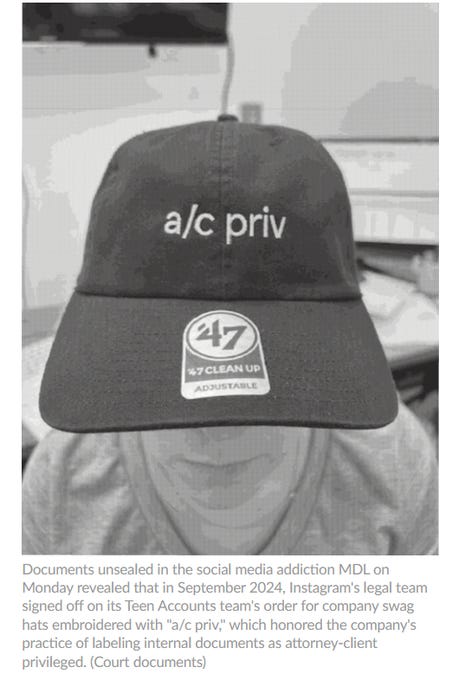
And now, the rest of the round-up. There are a bunch of important stories. For instance, cities are taking on surveillance pricing, teenage hackers are extorting the FBI, and bond yields are way up, which means Wall Street is saying there’s not enough global cash for all the data centers and wars. Oh, and it came out that Meta’s legal team actually made hats bragging about how they lie to the courts. All that after the paywall.
Good News
A favorable antitrust ruling as a judge says thousands of banks can collectively sue Apple over excluding competing tap-to-pay wallets on the iPhone, which they allege allows Apple to maintain higher transaction fees.
Seattle became the first city in the nation to pass legislation restricting surveillance pricing.
It turns out that being aggressive against corporations and banks is possible. The State of California seized a bank and placed it under federal receivership, following a string of enforcement actions which started in 2020. The State also barred some of its executives from the banking industry. The latest action was taken by the CA Dept. of Financial Protection and Innovation, a state-level CFPB, which in June 2026 came under the leadership of former CFPB Director Rohit Chopra.
Alvaro Bedoya and Lee Hepner joined The Lever to talk about the Paramount-Warner Bros. settlement.
It’s not a done deal. At a Thursday hearing on the Paramount-WB settlement, Judge Araceli Martinez-Olguin said that the court is “not a rubber stamp” of the parties’ settlement.
Senator Cory Booker, ranking member of the Senate Antitrust Subcommittee, sent a letter to the judge overseeing the Paramount-WB merger outlining the court’s authority to reject the consent decree. Now the judge is requiring the parties to respond to Booker’s letter.
I don’t have high hopes this will lead the court to block the settlement, but it’s a strong letter and good that the court is taking Congress’s concerns seriously.There’s now a bi-partisan film tax credit introduced in Congress. A film tax credit is fine, but it’s telling that Congress only seems to know how to govern in one direction.
For example, it would be smart for Congress to make the film tax credit contingent on a revival of Fin-Syn Rules for streaming platforms, which both the Writers Guild and Trump’s Hollywood envoy Jon Voight have called for.State AGs in the Live Nation monopoly case are probing the Justice Department’s surprise mid-trial settlement. Good.
Earlier in the month, AELP submitted a comment telling the court to reject the settlement and focus on breaking up Live Nation and Ticketmaster.
Florida filed a price fixing lawsuit against PBMs and three insulin manufacturers - Eli Lilly, NoVo Nordisk, and Sanofi - who collectively supply 90% of the world’s insulin.
New York is suing Polymarket for operating an illegal, unlicensed gambling site.
A federal judge overseeing one of many social media addiction cases is forcing Meta to re-review 300 documents that it claims were protected from disclosure, after plaintiffs’ counsel drew the court’s attention to Meta’s “a/c priv” hats mocking their abuse of attorney-client privilege. Good work by the plaintiffs’ lawyers. The Bad News takeaway is that Big Law is a borderline criminal conspiracy.
Americans need to start realizing that a lot of people with money and power are, well, idiots. Former Disney CEO Bob Chapek implied a secret cabal that included his predecessor Bob Iger knew about Covid early, and used that info to undermine him. True crackpot stuff.
Private equity is going to ruin Big Law, as the firewall preventing non-lawyers from owning law firms disappears in the face of a financier onslaught. That’s fine with me.
Bad News
10-year Treasury bond yields spiked to 5.12%, their highest point since 2007, amid persistent inflation and reports that the United States is now paying more in interest alone on its $40 trillion debt than it does on defense or Medicare.
Billionaires have raised $227 million to oppose a one-time tax on billionaires in CA.
Katie Porter’s Bookstagram must not be going well. Three months after publicly retiring from politics, she’s back with a very cynical op-ed opposing the Prop 40 one-time billionaire tax because it “does nothing to reform our healthcare system.” Ok.
It turns out half of Live Nation’s 64 amphitheaters in the U.S. are actually government-owned and leased to Live Nation on highly advantageous terms. The government is buttressing Live Nation’s monopoly.
Democratic old guard people simply cannot think and do not keep up with law. For instance, Senator Michael Bennet, a milquetoast corporate Democrat from Colorado, is proposing an “independent federal agency to regulate AI and big tech.” Aside from the fact that we already have the Federal Trade Commission, the Supreme Court just declared that independent agencies are unconstitutional.
Get the FTC to enforce the law, don’t spend a few years setting up a new agency that will also not enforce the law. Oh, and you can’t pretend that “independent” agencies exist anymore. They don’t. It’s all run by Trump.The M&A boom continues. In the well management space, Superior is buying an innovative company called Welltec. Welltec makes robots that fix wells more cheaply than full rigs, and it's being acquired by a Houston-based oilfield services conglomerate.
In the waterproofing space, which is already consolidated, RPM is buying Volteco, a European firm that has specialized technology to deal with moisture prevention in old buildings.
AI is already inflating healthcare costs. Researchers found that AI is pushing patients into higher-severity, higher-reimbursement billing categories. Increased diagnoses are not resulting in more treatment, but correspond with 70% of the increased costs at healthcare facilities from 2023-2025.
The Justice Department filed a brief with the Supreme Court supporting Apple’s ability to circumvent a federal antitrust court order.
And recall, last week the Justice Department filed a brief supporting Paramount-Warner Bros. request for a $1.9 billion bond pending resolution of the States’ and WGA’s merger challenge. Sensing a pattern here?
Why would anyone want to work for the FTC or DOJ Antitrust Division if their supervisors won’t let them investigate, impose onerous processes, and don’t know how to litigate cases? The brain drain continues.
Apple TV+ is increasing its subscription prices 15% to $14.99/month. You may have gotten an e-mail about it. That email may have gone to your junk folder.
Apple last increased prices by 30% just one year ago. When Apple TV+ launched in 2019, it was $4.99/month.The Trump-Vance FTC just eliminated post-employment restrictions. Now FTC regulators can go straight to work for the businesses they were in charge of regulating. This is the revolving door of corruption.
Paramount is reportedly seeking additional equity investment to close its Warner Bros. merger from Elon Musk.
Meanwhile, the major social media platforms are all rejecting paid ads for Alex Gibney’s new documentary, “Musk,” a week after Universal faced blowback for reconsidering its overseas distribution of the movie. Consolidation leads to censorship.
Remember when the Trump-Vance FTC enforced against ad companies for allegedly forming a cartel to boycott Twitter/X? Does anyone think the FTC will be as attentive to censorship cartels this time?Paramount is reinforcing its media empire. RedBird Capital, one of the major backers of Paramount-WB merger whose managing partner sits on Paramount’s board of directors, inked a deal to buy Puck, a news media upstart that covers Hollywood. Puck had faced criticism for its pro-merger slant while its own acquisition was pending.
Film industry analysts expect the Paramount-WB merger to prioritize blockbusters over “prestige” films. Basically, more remakes, sequels and IP reboots over riskier original content. The same thing happened with the Disney-Fox merger.
A really key story is the Trump-Xi meeting this week, in which the U.S. organized all sorts of pomp for the Chinese leader, including Chinese flags flying over the White House. Trump is generally perceived to be ‘tough’ on China, because he talked about how the country has been ripping off the U.S. for decades. But his policies vis-a-vis China have been characterized by meekness and fear, and the Chinese now believe they have ‘tamed’ the United States, as analyst Rush Doshi noted. There was no statement from the American read-out on the meeting about Taiwan, which is somewhat ominous. And tariffs against China are coming down, so we can expect more offshoring to that country.
“Want to meet a victim of Donald Trump’s tariff war? Let me introduce Hank, a figment of my imagination.”
That is actually the start of a real op-ed in the Financial Times. America is getting itself set up to be de-industrialized, yet again.The FBI just declared a “cyber security incident” related to the hack of FBIjobs.gov by a prolific group of teenage hackers. Now the hacker group ShinyHunters is extorting the government under threat of publicly exposing undercover agents and high-ranking FBI personnel. A former FBI cyber agent says staff are furious about “sloppy and lazy security failures.”
So that’s the round-up. What’s on your mind?