Hello, I’m Lee Hepner, an antitrust lawyer and policy advocate. I’m subbing in for Matt Stoller while he’s on paternity leave.
This week, Waylon Cunningham at Reuters looked at how McDonald’s prices its food and found a key reason why Americans are mad at the cost of living. Cunningham examined the way the restaurant chain prices its menu items across the U.S. and the world. In short, McDonald’s charges different prices for the same item, depending on where you are. And as it turns out, there is AI behind it; the company is “using artificial intelligence to guide menu prices across the U.S. and some global markets, a plan that aims to boost headquarters’ profit but risks alienating customers and attracting antitrust scrutiny.”
McDonald’s has a pricing algorithm for its 14,000 franchisees, generating what it “calls ‘the optimal price’ at each location for each menu item.” It draws upon data from millions of transactions by its own restaurants, as well as public data:
Screenshots of the interface franchisees use, reviewed by Reuters, show messages including: “Your restaurant is showing MEDIUM SENSITIVITY to Price” based in part on “customer willingness to pay in your area.” The platform also contains public price information pulled from online menus of nearby restaurants of competitors including Wendy’s and Burger King. Those chains said they do not use AI in pricing decisions.
There are different prices for the same item between restaurants, not just between cities, but nearby neighborhoods:
A Reuters check of prices in September on the McDonald’s mobile app showed price differences. For example, a company-run store in Fresno, California sells a Big Mac for $5.69, but another company-run restaurant two miles away sells the same sandwich for $6.89, a 21% premium.
This story went viral, unsurprisingly, with people expressing revulsion at extraction, and a familiar anger at how tech innovation and AI seems to be mostly aimed at cheating people.
I’m one of the many experts who Waylon spoke to for his story. And what I’ve seen, not just with this story, but with AI-enabled pricing games I’ve written about for years, is a righteous and justified anger in this country over the fact that prices are becoming less predictable, less transparent, and less fair.
For much of our history, stable, public pricing was the binding agent of a shared social contract. A few months ago, BIG pointed out that the longest running game show in history, The Price Is Right, which would be inconceivable without it. So the violation of that contract by an institution as American as McDonald’s, with its iconic Golden Arches, has understandably fostered rage.
This violation of the social contract is masked by the takeover of commercial discourse by economists, with their dry view that supply and demand curves are all that matters. But buying and selling are social experiences, too. Historically, if you wanted to know if a vacuum cleaner was worth its price, you asked a friend, family member or coworker, confident that their understanding of its value was based on the same price.
Stable and consistent prices have a fairness and competitive rationale; more price sensitive consumers can seek out better deals, creating downward pressure on prices — even for less sophisticated or less price sensitive shoppers. Retailers, for their part, have to justify their prices to the broadest group of consumers, and the fear of failure motivates improvements in product quality, or investment in solutions that drive down costs. New market entrants could set their prices below the incumbent, secure in the knowledge that they are giving a better deal than the existing market offerings.
To give you a sense of how deeply shared that social contract was, consider that in 1986, The Economist actually created a price index called “the Big Mac Index,” which compared the purchasing power parity between 15 countries (at the time, now over 50) where McDonald’s sold its flagship burger. For decades, it remained a way to estimate the value of global currencies and implied exchange rates. Forty years later, “burgernomics” perseveres as an effective solution to the challenge of comparing prices on identical shopping carts around the world. With slight variation, a Big Mac is basically the same wherever you can find it.
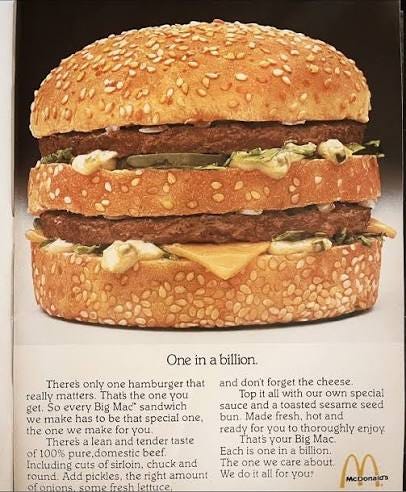
But that implied contract has broken down. How can you identify the price of a Big Mac when the price of the same Big Mac is dramatically different, even within a two-mile radius?
And there’s a broader dynamic here. A few months ago, former NEC Director Lael Brainard and former CFPB Director Rohit Chopra described how even well-off families are struggling with higher prices. It’s the dark underbelly of otherwise positive economic indicators. By a factor of four-to-one, Americans said that paychecks aren’t keeping up with rising prices. Respondents were evenly split among three worries: prices that are too high, prices that change unexpectedly, and the sense that they are getting less bang for their buck because of hidden fees and diminished product quality.
These phenomena are of course not unique to McDonald’s. In a sense, we’re now talking about a new Big Mac Index, one that says, “If it’s happening at McDonald’s, it’s happening systemically.”
How McDonald’s Betrayed Its Legacy
How did this company turn away from its tradition as a low-cost provider of fast food? There’s a fascinating aspect of this story that most people would not intuitively understand. There are two sets of victims here, consumers and restaurant owners. You see, McDonald’s is not actually one company, it is a constellation of them. The parent corporation is a franchisor, owned by shareholders and trading on the stock market, that licenses its name and methods. Then there are the thousands of franchisees, independently owned and operated, who license from the parent company.
The basic franchisor-franchisee relationship allows McDonald’s to hold its franchisees to brand standards that ensure consistency in appearance, taste, and quality. But, as independent business owners, franchisees “maintain control over all employment related matters, marketing and pricing decisions.” There is tension in this relationship, most famously exhibited by franchisees trying to hack the ice cream machines they are forced to use because those machines are always broken, while the parent company gets kickbacks from the machine vendor.
But the decentralization of control among franchisees also brings benefits, with many key innovations coming from franchisees themselves, like the Egg McMuffin, the Filet-O-Fish, and even the Big Mac. McDonald’s has also long represented — and continues to represent, despite emerging evidence to the contrary — that its franchisees are allowed to set their own prices. That’s why when you see national price campaigns, they’re often accompanied by a disclosure that the offer is available “at participating restaurants.”
That quid pro quo relationship would be upended if McDonald’s were usurping the ability of franchisees to make their own pricing decisions. Here’s how a McDonald’s executive responded to the Reuters story:
Yet it seems very possible, if not likely, that this dynamic has fundamentally changed. The franchisees themselves are unhappy with the parent company’s choices, which is evident from the fact that franchisees were the main sources for the Reuters article. And many of them now claim that deviating from Corporate’s price recommendations is not as easy as its executives or SEC statements would make it seem.
For the McDonald’s parent company, it’s likely that stable, nationwide price points began to disappear altogether in 2019. That’s when it bought Dynamic Yield Ltd, described at the time by McDonald’s Corporate as a “leader in personalization and decision logic technology.” Around the same time, it also partnered with Tiger Analytics, the third party AI-based pricing engine that Corporate uses to recommend prices to franchisees.
McDonald’s was operating consistent with a trend among many other large corporations. Seven years earlier, Home Depot acquired data pricing firm BlackLocus to optimize its pricing strategies. RealPage, the company that has become synonymous with rent fixing among the nation’s largest landlords, acquired algorithmic pricing firms Yieldstar in 2010 and Rainmaker Group in 2019. A few years later, Instacart acquired algorithmic pricing firm Eversight in 2022.
Each of these acquisitions constituted a broader trend in which major sectors of the economy have gained access to tools that process immense portfolios of data - including personal data and proprietary data shared between competitors - to “optimize” price. As part of this trend, predictable pricing has given way to constant price experiments, and price competition has given way to vast cartels. “Optimization” became a euphemism for maximizing corporate profits.
Maximizing corporate profits is also a market structure problem. The ability once held by consumers to collectively object to standard prices is replaced by an asymmetry of power, where retailers have off-loaded the risk of price competition - that is, the risk of setting a price too high and losing customers to competing retailers, or too low and leaving revenue on the table - to consumers, who can no longer tell if they’re getting a good deal at all.
The McDonald’s pricing tool is mostly opaque, but we can venture some guesses about what data they are relying upon to optimize their prices. First, as Reuter’s reports, McDonald’s scrapes public pricing data from nearby competitors like Wendy’s and Burger King. On the basis of that public data, McDonald’s pricing might be described as “following the leader,” setting prices that are aligned or competitive with other burgers. At a basic level, this is little different than the normal practice of doing market research to set a competitive price. But when “follow the leader” pricing is automated and instantaneous, beneficial price competition begins to look a lot more like price matching and the softening of independent decision-making.
It wouldn’t surprise me if McDonald’s is also utilizing census-based income or other demographic data to charge more for a Big Mac in, say, higher-income geographic zones or where there is another basis for inferring higher demand and lower price sensitivity. And that’s because we’ve seen a version of this before, when Princeton Review was caught charging higher prices for SAT tutoring in zip codes with disproportionately high numbers of Asian residents. The “Tiger Mom Tax” attracted outrage when exposed in late 2015, but Princeton Review defended the disparate effects as incidental to their assessment of localized demand.
Past experience suggests another possible data input for hiking prices: the distance between McDonald’s and a lower-price alternative. In 2022, mega-retail chain Target was sued by a group of California District Attorneys for allegedly geofencing its prices to show higher in-app prices to customers when they were in close proximity to Target, and, crucially, further away from a lower-cost retailer. Target settled that lawsuit for $5 million, which was basically the cost of avoiding further disclosure of their pricing algorithm. So McDonald’s may very well be “pulling a Target,” charging higher prices at stores that are further away from their competitors.
The Case for Price Optimization
I’ve testified before state legislatures and in Congress on pricing strategies for years, and I have strong views. But what’s the argument for the other side? Well, there’s a popular view among orthodox economists, trade associations, and corporate lobbyists that price discrimination and optimization will lead to lower prices for lower-income consumers.
These kinds of arguments have long been the coin of the realm for neoliberals; Obama’s Council of Economic Advisors Chair Jason Furman, in 2005, wrote a piece called Walmart: A Progressive Success Story, making the case that big firms that can price discriminate will lead to lower prices for consumers.
With more modern forms of price optimization, the key evidence comes from an oft-quoted study by economists Jean-Pierre Dube and Sanjog Misra at the University of Chicago Booth School of Business in collaboration with ZipRecruiter.com. They found that personalized pricing resulted in a 19% increase to ZipRecruiter’s profits and – the critical conclusion – over 60% of consumers paid a price lower than the optimized price. To oversimplify, while the rich paid more, the lower income consumers paid less. And ZipRecruiter earned a tidy profit.
That’s a win, win, with some redistribution in there, as a cherry on top. Right?
In my advocacy efforts before state legislatures across the country, that 60% figure is a totem for industry proponents of AI-based pricing technologies. It is virtually memetic in its regurgitation, and instantly compelling to lawmakers who are disproportionately terrified of doing anything that could upset the function of technologies that might deliver lower prices amid an affordability crisis.
The thing is, the study by Dube and Misra was, well, highly misleading, and that might even be a polite way of putting it. They based their study not on the actual price of ZipRecruiter at the time of the study, which was $99. No, instead they calculated something called the “uniform optimized price,” which they set at $327, and compared everything to that. So, while 60% of consumers paid less than their made-up price of $327 under personalized pricing, every single consumer paid more than the $99 actual price.
In other words, most legislators are basing their policy decisions on a study that any normal person would acknowledge is made up. Following the study, ZipRecruiter didn’t pivot to a personalized pricing model. It did, however, increase its standard price from $99 to $249.

How to Return to Honest Business
Ultimately, the villain in this story isn’t really your local McDonald’s, but McDonald’s Corporate, the franchisor. If it were up to the franchisees themselves, pricing would likely be more fair. It would certainly be more competitive. In other sectors, like groceries, independent businesses don’t like when their pricing, consumer relationships, and other competitive terms are dictated by a centralized platform. In this sense, the relationship between McDonald’s Corporate and “independent” franchisees is little different than the relationship between Instacart and independent grocers, or Amazon and its third-party sellers.
Hopefully, this story sets off alarm bells among policymakers and enforcers. We can even point at the policy decisions where things started going south, like when the Supreme Court decided one day in 2007 that it was more-or-less fine for upstream suppliers to restrict downstream prices. I think Congress should be more offended when the Supreme Court usurps its policymaking authority, which is exactly what happened. That 2007 case, known colloquially as Leegin, was a seismic policy shift that has, over the past 20 years, explained a transfer of power from independent businesses to e-commerce platforms and other central planners. The McDonald’s story is a symptom.
There are other laws that enforcers can use today. For instance, California just passed a law last year that would prohibit companies like McDonald’s from engaging in behavior to coerce its franchisees to accept Corporate pricing recommendations. At first blush, it appears that’s exactly what McDonald’s is doing. I may be more bullish than others on this front, but I wouldn’t be surprised if an enterprising plaintiffs lawyer spots a Big Opportunity in the Big Mac pricing scandal. It is also quite possible to use unfairness statutes, either state or Federal, and our foundational antitrust laws, to address the hoarding of data as a bottleneck to competition. It’s also ripe for legislative action, and lawmakers across the country are starting to harness righteous consumer indignation.
But fundamentally, building good policy requires new forms of politics. To that point, I attended a book release party last night for Lindsay Owens’ new book, Gouged: The End of a Fair Price - And What That Means for Your Wallet. I had an opportunity to read an advance copy and can confirm it’s a tour de force, equal parts outrageous, informative, and entertaining. There are rumblings of a new consumer rights movement in this country, and if you want to understand where it’s coming from and where it’s headed, go pick up your copy of Gouged today.
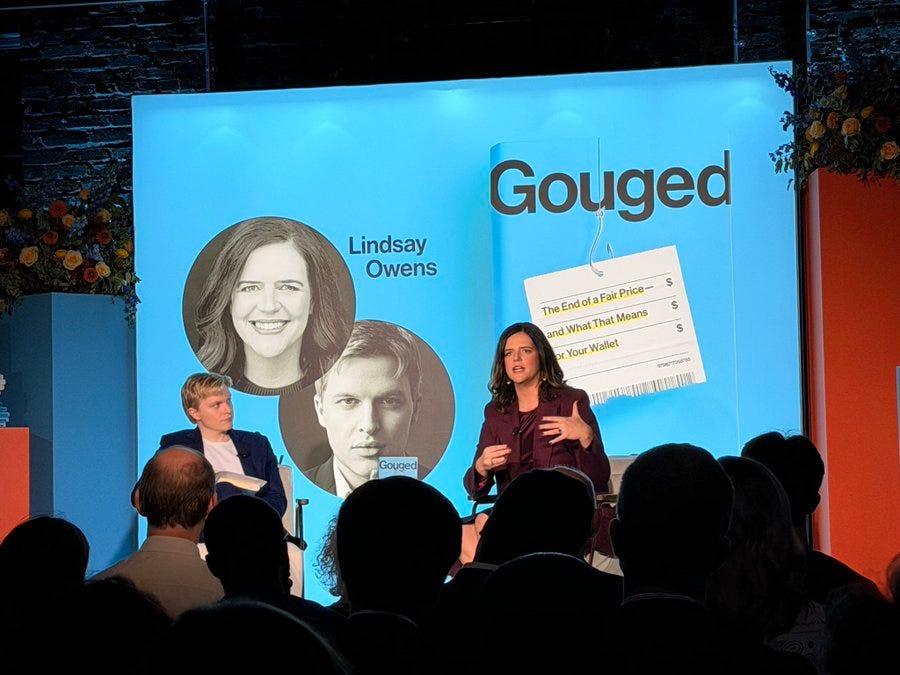
On a basic level, setting aside the wonky details of what McDonald’s is actually doing, or whether it’s even legal, there’s a certain poetry in the collective outrage directed at McDonald’s. From the shredding of one form of social fabric emerges a new kind of social cohesion, a shared sense of anger that is beginning to feel powerful enough to do something about it.
It would be a too-convenient generalization to say all of this is attributable to AI-based pricing tools, which are restructuring markets in relentless pursuit of higher prices, with little evidence that things are materially improving. I’m not sure it’s that big of a stretch, either. All of this is starting to seem about as American as the Golden Arches.
BIG is a reader-supported publication. To receive new posts and support this work, consider becoming a free or paid subscriber.
Thanks for reading! Your tips make this newsletter what it is, so please send tips on weird monopolies, stories I’ve missed, or other thoughts. And if you liked this issue of BIG, you can sign up here for more issues, a newsletter on how to restore fair commerce, innovation, and democracy. Consider becoming a paying subscriber to support this work, or if you are a paying subscriber, giving a gift subscription to a friend, colleague, or family member. If you really liked it, read my book, Goliath: The 100-Year War Between Monopoly Power and Democracy.
cheers,
Matt Stoller