Welcome to the Monopoly Round-Up. I’m Lee Hepner, an antitrust attorney filling in for Matt while he’s out on paternity leave.
One of the things you realize pretty quickly when putting together these weekly round-ups is just how much news happens in a given week. In the past seven days, we’ve seen significant developments in the restructuring of major industries across the economy, from college sports, to entertainment, to fast food and food itself. Heck, even the Holy Father weighed in on the “art” of AI slop:
And one of the reasons I look forward to this newsletter every week is that it highlights big things that fly under the radar, while providing the connective tissue to understand both corporate power itself and those who are taking it on. The good and the bad of it all is below, for paid subscribers only.
But before we get to that, I want to talk about three under-the-radar developments that explain why the food Americans eat is overpriced and often poor quality. Two involve seed monopoly Corteva (a spinoff of DuPont), and the third involves one of the largest alcoholic beverage distributors in the country. All three illustrate how the root of high inflation is actually corruption.
The Seeds of Inflation
One of the things we hear a lot about is high food prices to consumers. So one would think that farmers, who ostensibly receive these high prices as income, would be doing well. But they are not. Take Arkansas, where soybean farmers are shutting down under financial distress. Some is due to Chinese trade tensions, but there are other factors at work. Diesel, fertilizer, seed, and pesticide costs are all up. Soybean seed prices alone have nearly tripled in the past 20 years.
In 2025, Arkansas soybean production generated a negative $85.02 return per acre. In 2025 alone, Arkansas saw 33 Chapter 12 bankruptcy filings, more than twice the number in 2024 and the highest of any state, although the crisis is also sweeping across the Mid-South and Midwest. Commodity prices aren’t keeping up with rising input costs, and while rice farmers are being hit even worse, for Arkansas farmers across the spectrum, it’s the last straw.
What is bringing these rising prices to consumers, and yet lower prices paid to farmers? Monopoly power. Seeds, fertilizer, pesticides, tractors, and so forth are all locked down through a dense network of monopolistic contracts, market power, and intellectual property. The private jets and high corporate profits in gilded cities where agribusinesses typically locate provide stark contrast with escalating farm bankruptcies.
In 2022, Lina Khan, chair of the Federal Trade Commission, took steps to break apart this corrupt system. There was the right-to-repair case against John Deere. But the FTC also brought a case against pesticide manufacturers Corteva and Syngenta for exclusive dealing and unfair methods of competition. These companies had patents on pesticides, but those patents had run out. There were generic alternatives that were much cheaper. However, Corteva and Syngenta paid distributors not to carry cheaper generic alternatives.
It’s a lot like pharmaceutical firms, who often pay generics not to interrupt their expensive branded drug sales. In the case of pesticide firms, they had their patents and then additional rights under the Federal Insecticide, Fungicide, and Rodenticide Act, or “FIFRA.” Their exclusive rights, which last for periods of 20 + 10 years, exist to provide an incentive for the costly development of those ingredients by granting developers like Corteva and Syngenta the right to exclude competitors from using their products without permission.
But once those exclusive rights expire, generic pesticide manufacturers, of which there are about a dozen in the United States, can enter the market using the same active ingredients. Generic manufacturers innovate by mixing different active ingredients together, and they also drive down prices. Distributors buy from generic manufacturers at a lower price and sell to retail outlets across the country, who then sell to farmers.
The 2022 lawsuit alleged that Chinese-owned Syngenta and American-owned Corteva, the second and third largest pesticide manufacturers in the United States, with monopoly-level market shares in inputs for specific crops, violated the law by blocking generic competitors even after their exclusive use periods had expired. They did so by operating “loyalty programs” that essentially bought off distributors with rebates, or kickbacks, on the condition that distributors buy 85% or more (in some cases 99%) of their products from Corteva and Syngenta.
By locking generic competitors out of distribution channels, Syngenta and Corteva were able to maintain higher prices, while leaving only a sliver of the market for the dozen-or-so generic competitors to enter and achieve the scale necessary for success. Part of the reason Corteva and Syngenta were so successful at this is because the national distribution market is also concentrated - just 7 distributors control over 90% of the market.
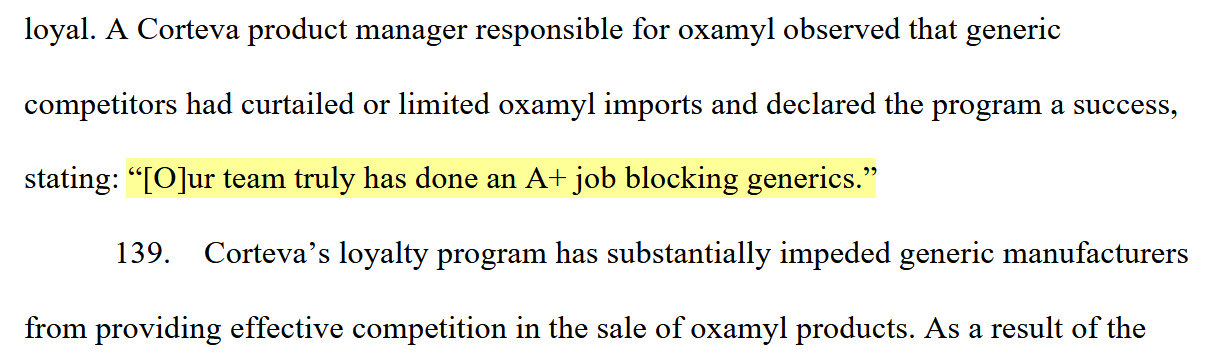
How effective were these loyalty programs at locking up distribution? According to a Corteva product manager cited in the FTC’s Complaint: “[O]ur team truly has done an A+ job blocking generics.”
This is the business model: Dominate the manufacturing market, lock up distribution channels to prevent competitor entry, maintain higher retail prices for farmers. Farmers pay higher costs to produce food, only to be squeezed on the other side by dominant buyers, who are the food distributors that sell to grocery stores at further inflated costs. Ultimately, it’s you, the everyday consumer, that pays the price.
Meanwhile, politicians are wringing their hands over higher grocery prices. The cost of living is the top concern among American voters today, and the rising price of groceries is at the top of the list of anxieties. So this wonky kickback scheme is part of the most important political issue of our time.
That’s case one. And the story here is that the Trump FTC Chair, Andrew Ferguson, basically issued a corporate pardon to Corteva and Syngenta, with the seven co-plaintiff states going along. I’ll get to the specifics below, but I want to introduce the second case, because the two are related.
The Silver or the Lead
Case two came shortly after Lina Khan’s FTC filed its lawsuit against Corteva, when Corteva filed a separate multi-billion dollar lawsuit against Inari for allegedly infringing Corteva’s patented seed technology. You see, Corteva isn’t just a major pesticide manufacturer, it is also one of the largest overall providers of inputs for food production. In 2025, Corteva had 22,000 employees and reported $17.4 billion in sales based on operations in 110 countries. It’s a behemoth in our food system.
Inari, by contrast, is (or was) a nascent competitor with just 200 employees and $720 million in equity raised - and the enormous potential to disrupt the Syngenta-Bayer-Corteva seed oligopoly. Inari’s innovation is the use of gene editing technology, which takes existing genetic material, uses AI to identify desirable edits, and creates new genetic seed configurations that it then licenses to seed companies. The Corteva lawsuit was likely designed to destroy Inari as a going concern.
In response, Inari filed counterclaims against Corteva, alleging that Corteva was abusing its patents to prevent legitimate competition. So the question presented in the Corteva v. Inari litigation was about the line between Inari’s new gene-edited inventions and its allegedly unauthorized use of Corteva’s patented technology. Framed another way, Corteva was wielding its patent rights not merely to exclude generics from directly competing, but to exclude Inari from accessing genetic material to create the next generation of seed products.
Both of these mammoth cases settled this past week, Corteva v Inari on September 28, and FTC v Corteva on September 29. The most important thing to know about the Corteva-Inari settlement is that it’s mostly secret. And good things involving monopoly power rarely happen in secret. What we do know, from Corteva’s declaration of victory, is that Inari has to destroy all of the Corteva material it had used to develop new genetic material, destroy all of that developed material, and assign its IP back to Corteva. What Inari gets from Corteva is anyone’s guess, but my guess is it looks a lot more like Inari becoming a subsidiary of Corteva — market disruption be damned.
We will never know whether a sympathetic jury may have decided otherwise. And we may never know the details of the secret deal between Corteva and Inari. What we do know is the one party that may have been key to unraveling Corteva’s historic stranglehold on the marketplace is cracking its deal. Given the choice between a bullet or being cut in, Inari took the deal.
What about the FTC case? Well that settlement preserves Syngenta’s and Corteva’s ability to lock up 50% of distribution channels and does nothing to address the fact that Corteva can, for instance, still refuse to license data under its FIFRA data rights, even if its patent is expired, or otherwise restrict competitor access to manufacturing capacity. It is basically the FTC signing off on illegal behavior.
Make Bullying Small Producers Great Again
Third and finally, this week the FTC also settled a major price discrimination lawsuit filed by Lina Khan’s FTC against Southern Glazers, the largest distributor of alcoholic beverages in the country for 28 years running. That case sought to revive the criminally under-enforced Robinson-Patman Act, a law once dubbed the “Magna Carta” of small business competition.
The case alleged that Southern Glazers had forced small retailers to pay wholesale prices that were 12% to 67% more than large chains for the same wine or spirits in the same geographic area, destroying their ability to fairly compete. And it ended with less than a whimper, with a tortured order that looks more like an attempt by the FTC to water down existing law while preserving Southern Glazer’s ability to weasel its way out of compliance.
In just one week, two corporate pardons from the FTC, and another settlement that looks like a corporate version of Pablo Escobar’s “Plato o plomo,” or the “silver or the lead.”
This is far from a new narrative for readers of BIG. These are simply new data points of a corrupt system that has long chiseled corporate hegemony into stone. But the purpose of this column isn’t just to preserve that record, but to show how another kind of politics is possible.
A New Farmer-Consumer Movement?
For much of American history, farming was our main economic activity. And a key reason for high productivity farms was that the Federal government, as far back as the early 1800s, focused on ensuring that Americans could access a wide variety of seeds that would grow in different soil varieties and climates. Seeds were understood as a public good.
As with much in the neoliberal revolution, in the 1970s and 1980s, much of this public infrastructure was shut down, and Congress and the courts implemented new patent rules to privatize this commons. Monsanto and Bayer took over huge swaths of farming capacity, using engineered seed and genetic varieties and these new rules. Monsanto even organized its strategy in the 1990s based on how Microsoft leveraged its operating system to dominate office productivity.
Farmers were the principal social base and organizational force behind the late-19th Century populist movement. Today, we may be seeing the seeds, if you will, of a similar resurgence. Last week, I was in DC, where I met with farmers from east Iowa and Texas about fertilizer monopolies. One of those farmers, Lance Lillibridge, recently spoke out about how the Paramount-Warner Bros merger looked a lot like what he was facing at the hands of fertilizer companies Nutrien and Mosaic.
Meanwhile, Representatives McGovern (D-MA) and Casar (D-TX), both members of the Congressional Progressive Caucus who don’t exactly hail from agrarian-rich districts, have introduced the Fair Seeds for Farmers Act to deliver structural relief to farmers. An alliance between rural farmers and urban/suburban progressives shows a new path forward. But it can’t happen through technocratic work by regulators that can be easily overturned by malevolent public officials. It has to be supported by a real broad political base.
If the populist anger we’re seeing everywhere can be turned into coherent politics, then we can overturn this system and build something better. That’s the hope, anyway.
Now, on to the Good and the Bad news, including a major development on FICO credit scores, legal trouble for Flock license plate readers, and surveillance pricing on one of the hottest tickets in pop music.
Good News
In a man bites dog move, the White House just crushed a noxious AI monopoly, the Fair Isaac Corporation, better known as “FICO.” FICO provides the algorithm for credit scoring, and is a government granted monopoly in mortgage lending. When you try to borrow money, you need a FICO score, or else Fannie and Freddie, the housing finance firms owned by the government that manage the mortgage market, will not buy your mortgage on the secondary market. That means mortgage lenders had to buy FICO scores to do business. FICO in turn raised its prices nearly 1500% since 2022.
Fannie and Freddie just said they’d accept a rival score to FICO from mortgage lenders. This rival, Vantage Score, is cheaper and has a slightly more lax approach to credit quality. In addition, Fannie and Freddie are now both open-sourcing their own internal credit scores, which means that eventually there could be four competitors in the market for a credit scoring algorithm.
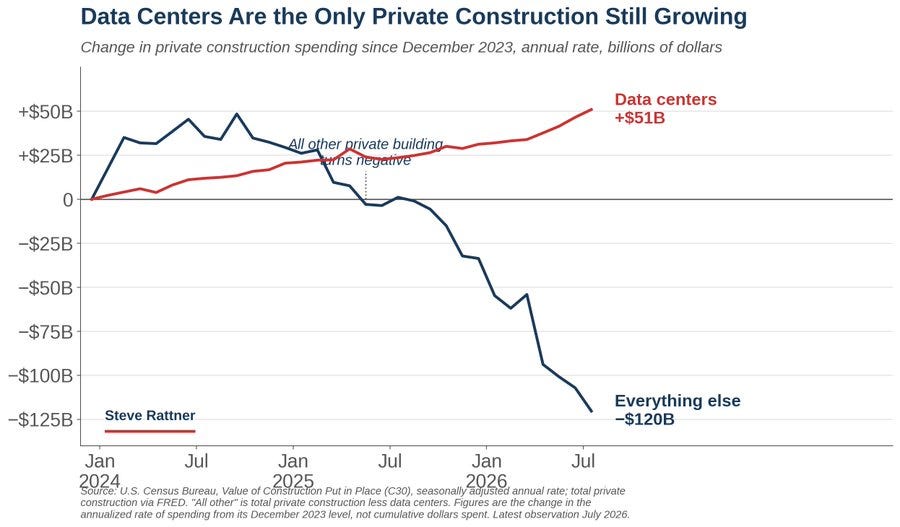
Nothing about this move makes sense, but it’s kind of great. Billionaire nepo baby Bill Pulte, the Trump head of the Federal Housing Finance Agency, is the mastermind behind it. I’ll have more soon. FICO stock dropped by 27% on one day alone, and is down by almost two thirds since Trump took office.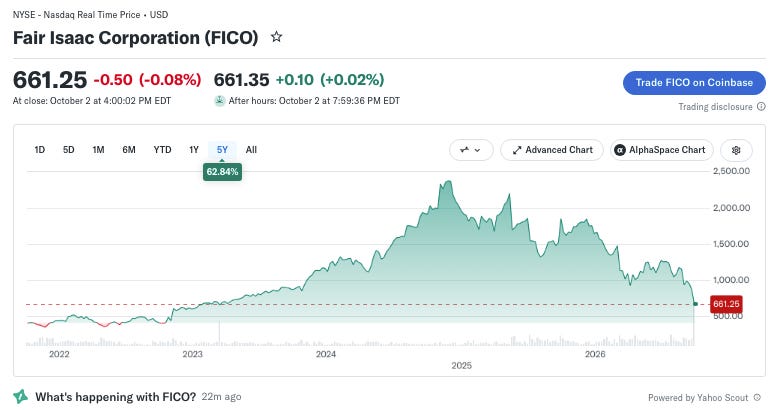
Upon news that the FTC had settled its case against Southern Glazers for peanuts (mentioned above), California BCSA Secretary Rohit Chopra announced an investigation of the beverage behemoth’s state-issued licenses.
New Mexico is asking for a real penalty against Meta after the company lost a jury trial over its deception in the Cambridge Analytica matter. Finally. The state wants between $35-40 billion, which would ding the company, for real. "This court should speak to Meta in the only language it understands, which is money, and the value of its stock price," said a state official.
New York City’s click-to-cancel rule is now in effect for city residents. It’s now illegal to trap people in subscriptions that are hard to cancel.
In other New York City news, Mayor Mamdani and DCWP Commissioner Sam Levine won $131.5 million in an enforcement action against DoorDash for systemic violations of the City’s delivery worker laws. $115 million will go directly to workers.
Former Trump Antitrust AAG Gail Slater is heading to White and Case, a Big Law firm. Slater was fired for being incompetent at both antitrust law and corruption, but has managed to convince some antitrust insiders that she’s a martyr.
A judge ruled that Ticketmaster and Live Nation have to go to trial for illegally reselling hundreds of thousands of scalped tickets, according to the FTC and seven states.
Ruling on a motion to suppress evidence acquired by Flock surveillance cameras, a judge ruled that Flock’s license plate readers engage in “indiscriminate mass surveillance” in violation of the Fourth Amendment.
The U.S. government is good at venture capital, not in terms of return on equity, but return on what we need. Example:
Hertha Metals, a steel startup planning to produce high-purity iron for U.S.-made rare-earth magnets—essential to F-35 jet fighters and missile-guidance systems—has closed a $133.65 million Series A round that includes a $65 million equity investment from the U.S. government, its chief executive officer said.
Meanwhile, MP Materials, another partly government-owned firm, shipped its first rare earth magnet to General Motors for testing. GM bought into a domestic supply chain for rare earths years ago. Good for them.
And Cyclic opened a 25,000 ton rare earth magnet recycling facility in Mesa, Arizona. The investment started 18 months ago. It turns out that the U.S. can do real things if we invest in them.Viamedia’s antitrust claims against Comcast survive.
Google lost its attempt to throw out a case brought by publishers against Google’s Ad Tech monopoly. These private cases are where publishers are seeking damages, which is the only major upside after Judge Brinkema of the Eastern District of VA ruled against the DOJ’s requested remedies in the ad tech case.
AI tools may be disrupting the subscription economy. Hard to love AI being needed to fight deceptive practices made worse by AI, but I support AI-on-AI violence.
Wall Street is angry and demanding answers from “Skydance” (the newly-named combination of Paramount-Warner Bros) about its extraordinary debt load.
Lina Khan wrote a piece in the New York Times saying “enforce existing laws against AI.” Yup.
Right on cue, Florida AG James Ultheimer filed an emergency motion to block OpenAI from development of models without third-party safety approval, using the state’s law against unfair trade practices. It’s blistering.
Rep. Jamie Raskin was the keynote speaker at a Capitol Forum event on the future of state and federal antitrust enforcement. It’s a very good speech. If Democrats win the House, Raskin is the presumptive Chair of the House Judiciary Committee.
In conjunction with a Congressional probe of NDAs in data center development agreements, Rep.’s Raskin (D-Md.), Barrett (R-Mich.) and Landsman (D-Ohio) introduced legislation to ban secret deals regarding data center approvals. This is an issue that my colleague Pat Garofalo has written about extensively.
Bad News
A new report by the Brookings Institute predicts $10.3 trillion in spending on AI build-out projects from 2025 to 2032, or an average of 3.63% of U.S. gross domestic product per year, much of it financed by private credit deals that hide who actually owns the risk. That’s more than past industrial spending booms on canals, railroads, electrification, highways, and telecommunications.
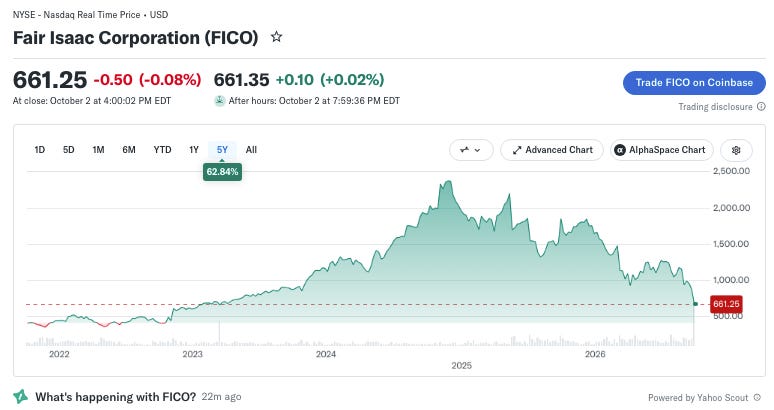
Meanwhile, data center construction is booming, while all other private construction is shrinking. Wait, aren’t we in a housing crisis?
More consolidation in food processing as Hormel acquires Brakebush Brothers for $1 billion. Hormel is a food giant with multiple brands, including Spam, Planters, Skippy, Jennie-O and Applegate. This one looks like building more market power in distribution and processing of proteins.
The Trump SEC is loosening rules so as to enable investment advisors to cheat their clients.
AP: “California Gov. Gavin Newsom vetoed legislation that would have penalized Californians for using smart glasses to record people without their permission in changing rooms, doctor’s offices and other spaces people consider private.”
Follow the money. The bill was heavily opposed by TechNet, one of many lobbying arms of Meta, Google and Amazon.Journalist Chris Leonard has an important piece on missile defense and contractors called the THAAD Delusion.
The Trump administration cut fuel efficiency requirements for cars and trucks, prioritizing internal combustion engine development even though EVs are clearly a superior technology.
Bloomberg is projecting another big airline merger, like Alaska and JetBlue.
The IRS made it easier for farmers to sell their farmland and defer capital gains tax, which will likely spur land consolidation.
Another day, another bank merger. Peoples Bancorp will buy Capital Bancorp. The number of U.S. banks is likely to fall from 15,000 in the early 1980s to a thousand.
The Federal Reserve is opening a comment docket on how to manage stablecoin payments, a requirement of its obligations under the crypto-friendly GENIUS Act.
If it looks like a duck and quacks like a duck, Kalshi and Polymarket are obviously gambling websites. NPR documents that for gambling addicts, the exploitation by these platforms is devastating.
Stubhub got caught surveillance pricing Harry Styles tickets.
A federal judge ruled that New York’s law to ban RealPage-style rent-fixing may violate RealPage’s constitutional right to free speech. I may write more about the First Amendment Right to Fix Prices.
Judge Mehta, who rescued Google from a breakup of its illegal Search monopoly, came to the rescue for Google once again, dismissing a case brought by publishers over Google’s AI Overviews.
The market leader in customer relationship management, Salesforce, just bought Listen Labs, which uses AI to do market research and polling more quickly. There’s already a long-standing roll-up in customer research technology.
The Antitrust Division cleared Transocean’s $5.8 billion acquisition of offshore drilling rig firm Valaris.
The Senate gave NCAA an antitrust exemption to gut athlete compensation. It was a bipartisan vote, but I’m hearing it will have a harder time in the House.
And that’s the news of the week. What’s on your mind?