The big news of the week was obviously the midterm elections. Antimonopolists soared in the midterms, as we wrote up earlier in the week. There were lots of other things, too, like the CEO of the most important chipmaker in the world being outed as having an affair with a Chinese spy, a major media distribution merger that represents the further consolidation of Hollywood and media, and one of the largest self-inflicted breakups in history. We’ll get into all of that. There’s a lot of good and bad news in the antimonopoly world, as usual, for paid subscribers after the jump.
First, I want to focus on the stock market crash last week, a decline that took place because of the midterm elections. What’s interesting is that the attitude of Wall Street and Silicon Valley leaders is generally unchastened. Many of those leaders lashed out publicly, making statements to the effect that the actions of voters are irrelevant.
And yet, the financial carnage was real.
On Thursday, the markets took their biggest single-day dive in 18 months. The S&P declined 4.36% and the NASDAQ ended the day down 5.52%, mostly centered in chip and big tech stocks. Some $3 trillion in market capitalization on the S&P 500 was wiped out in a single day, in large part due to fear that the Democratic wave election means the AI trade is over.
But here’s Jason Calacanis, a tech investor, advisor to Elon Musk, and co-host of the All-In podcast, taking it all in stride and impugning the conviction of voters:
Calacanis was expressing a common view among investors that elections don’t really matter. For instance, take 83-year old billionaire investor and Elon Musk-ally Ron Baron, who appeared on CNBC just two days after the election to give a preview of post-midterm investor mentality heading into his annual Baron Investment Conference (a name that sounds fake but isn’t). When asked whether he’s concerned about Congressional oversight hearings, targeting Musk or anyone else, he brushed it off. In fact, asked about Bernie Sanders and his opposition to data centers, Baron exclaimed “Who cares about him? He’s almost dead.”
That’s a shift. In 2016, Baron went on a press tour to talk about how much sleep he’d been losing over the possibility of a Trump presidency. “For weeks now, I’ve been so upset with this election. I wake up every night two or three times,” he said at the time. Now, however, when asked what he thinks about potential turbulence for AI, he responds that he doesn’t think about it. When asked what he thought about the midterm elections, he said he “slept through it,” and added, “I don’t think about elections.”
Musk himself, who played the biggest role over the last few years in conservative politics, aside from Trump himself, had a similar view. Texas, his home state where he has also domiciled his companies, went to his avowed political opponents. And yet, he simply dismissed any impact of the election on his own choices.
These men are not anomalies. Two days after the election, as the AI industry was facing the biggest market correction in well over a year, OpenAI CFO Sarah Friars said, “I don’t think there was something that dramatically changed for us.” Their plan following the midterms? Continue attracting capital investment, maintain Q3 momentum, keep course for an IPO, and — wait for it — rebrand “data centers” as “compute campuses.” Meta’s President is saying something similar.
Or look at Google, which has been found liable by at least three federal courts for illegally monopolizing markets spanning online search, digital advertising, and app distribution. How did Google respond to the midterms? They didn’t even wait for the results.
On Election Day, Google announced it would turn off classroom access to Google Search if schools sought to turn off Google’s AI tools. The backdrop here is the protracted and heated debate over the impact of AI on learning outcomes and child psychology. In September, school districts in both New York City and Los Angeles decided to restrict student access to AI in the classroom. Google’s response, to turn off its products altogether, could be a form of illegal tying in violation of the same antitrust law it has repeatedly violated.
There’s a reason for this refusal to temper behavior in response to a rejection by voters. Since the 1970s, no matter who is in office, big business has done well. JP Morgan for example advises investors, election after election, not to read too much into politics or election results. Here’s JP Morgan’s Head of Investment Strategy Elyse Ausenbaugh in 2024:
“Even as the politicians go and campaign on certain policy platforms, we should be very careful as investors about over-indexing any assumption how that may play out in markets.”
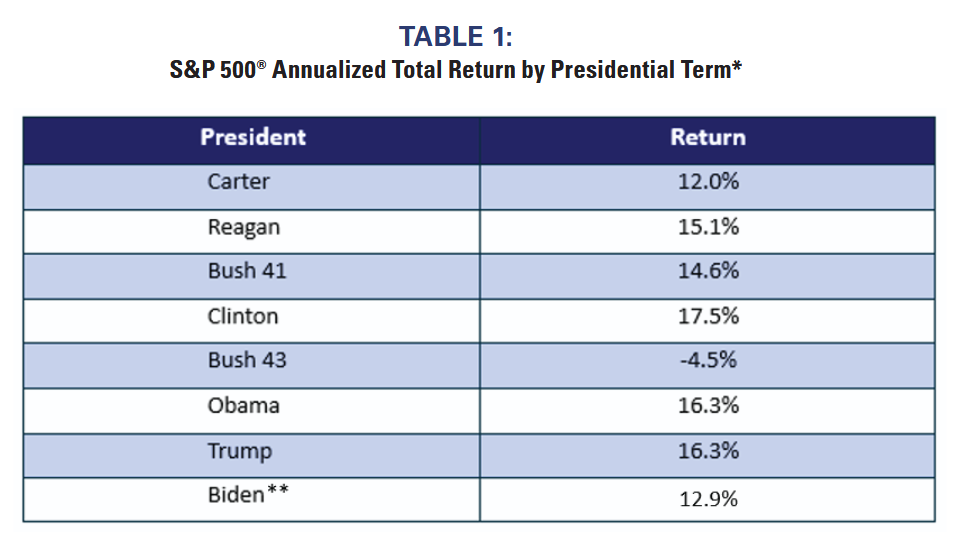
And it’s true. Seasoned investors have traditionally not cared about elections. Republicans feel better about the economy under Republican administrations, and Democrats feel better about the economy under Democrat administrations, but whether it’s Reagan or Clinton, Obama or Trump, the Number Go Up Rule has prevailed:
In terms of precedent, markets tend to perform well in the year following an election, at least over the past half century:
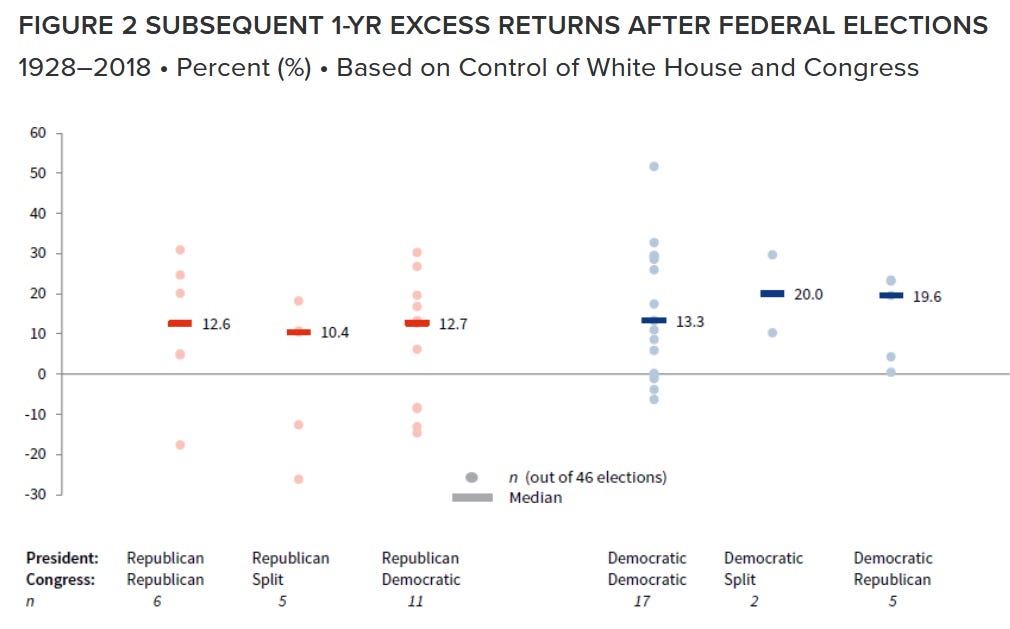
But here’s the thing. Economic populism hasn’t been the basis for an election this overwhelming since the 1930s. So all of those theories and precedents from Wall Street are just guesses based on a questionable sample size.
Moreover, market indifference to politics is a bipartisan creation of politics. For a recent example of this, rewind to the worst single-day in the market prior to last week, which was April 4, 2025, two days after Trump announced his Liberation Day tariffs. On that date 18 months ago, the S&P fell 5.97% and the NASDAQ fell 5.82% in a single day — worse than the midterm wipeout. How did Trump respond to the market revolt? It took five days of market turmoil for Trump to announce a 90-day pause to his reciprocal tariffs rollout.
Trump’s Liberation Day tariffs also faced the predictable partisan blowback, and they attracted legitimate criticism because they were chaotic, punitive, and non-strategic. But his capitulation was a response to the headwinds of market turmoil, which reveals the boundaries of government’s ability to manage the economy.
Perhaps it’s not surprising, then, to see investment kingpins bucking the midterm election results.
Industry Unchastened?
While politics might not really matter to market outcomes, the threat of actual policymaking does. And here’s where the stock market decline might suggest something different than what the confidence of Musk, Baron, Frier, and others implies.
Among the midterm mandates was a nearly universal, bipartisan rejection of data centers. Dozens of local jurisdictions voted against the construction of new data centers, an illustration of their bipartisan unpopularity. Texas has been a major target for data center construction and the climate now looks tougher there. And then there are predictions that Congress may not pass the pending permitting reform bill. The Bipartisan American Affordability and Jobs Act, or “BAAJA,” would be mostly good news for data center construction, if only because it offers the certainty that industry so craves to finance the build out.
Similarly, Google’s moves are being met by anger from some of the most popular and newer Democrats. Here’s how Mayor Zohran Mamdani responded on X:
And here’s what former FTC Chair and current Chair of NYC’s Economic Development Corporation Lina Khan had to say:
“This latest move shows it remains unchastened,” Ms. Khan said of Google’s new A.I. changes for schools. “As the public increasingly pushes back against the use of AI in schools,” she added, “Google is making clear it will punish those who don’t fall in line.”
“Unchastened.” And why wouldn’t they be? Google has been found liable for monopolization three times, and three times the remedy has done little. Why would OpenAI be chastened by a politics that treats big business as above the law? Why would Ron Baron be chastened by calls for accountability or controls on SpaceX, whether coming from Bernie or the new crop of economic populists, such that he would avoid going all in with Elon Musk on a merger of Tesla and SpaceX?
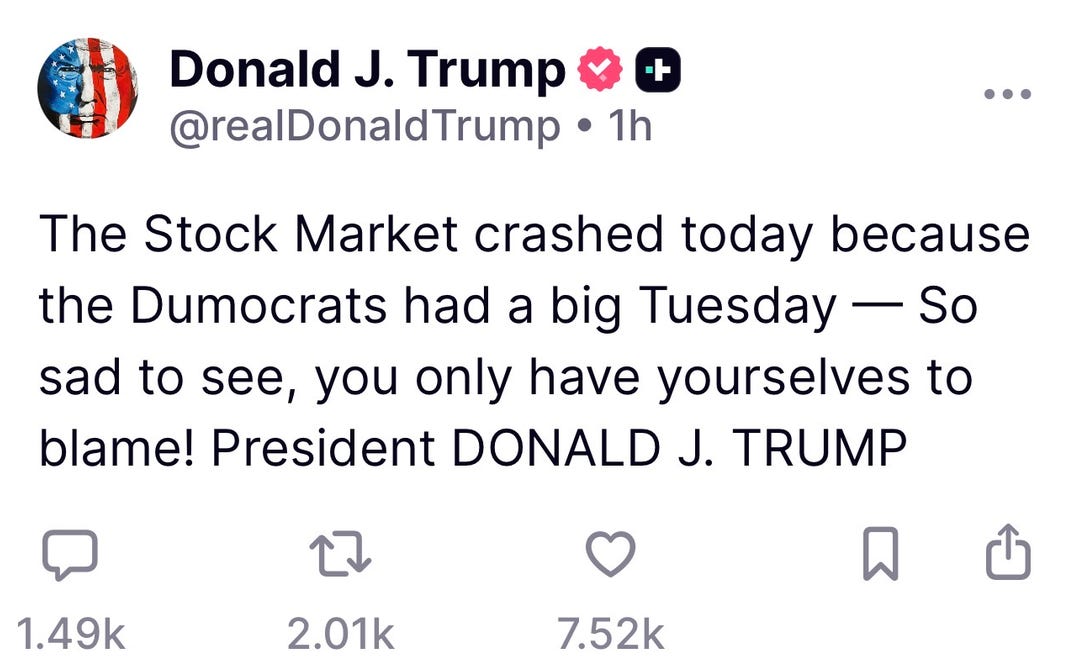
But then, there is the matter of a market crash on Thursday. And ironically, it was Donald Trump who acknowledged most notably that the election did matter. Here’s Trump on Truth Social blaming the tumbling market on “the Dumocrats” and the voters themselves:
Trump’s major policy choice has been to inflate an AI bubble, or to invest in U.S. dominance in AI, however you want to frame it. So the unwind over the last few days could be seen as a test of whether that policy will remain in place. With the dozens of ballot initiatives rejecting data centers, it’s hard to imagine there won’t be a shift. Already, the initial public offering of Anthropic, which is existential for Wall Street and Silicon Valley, is tottering.

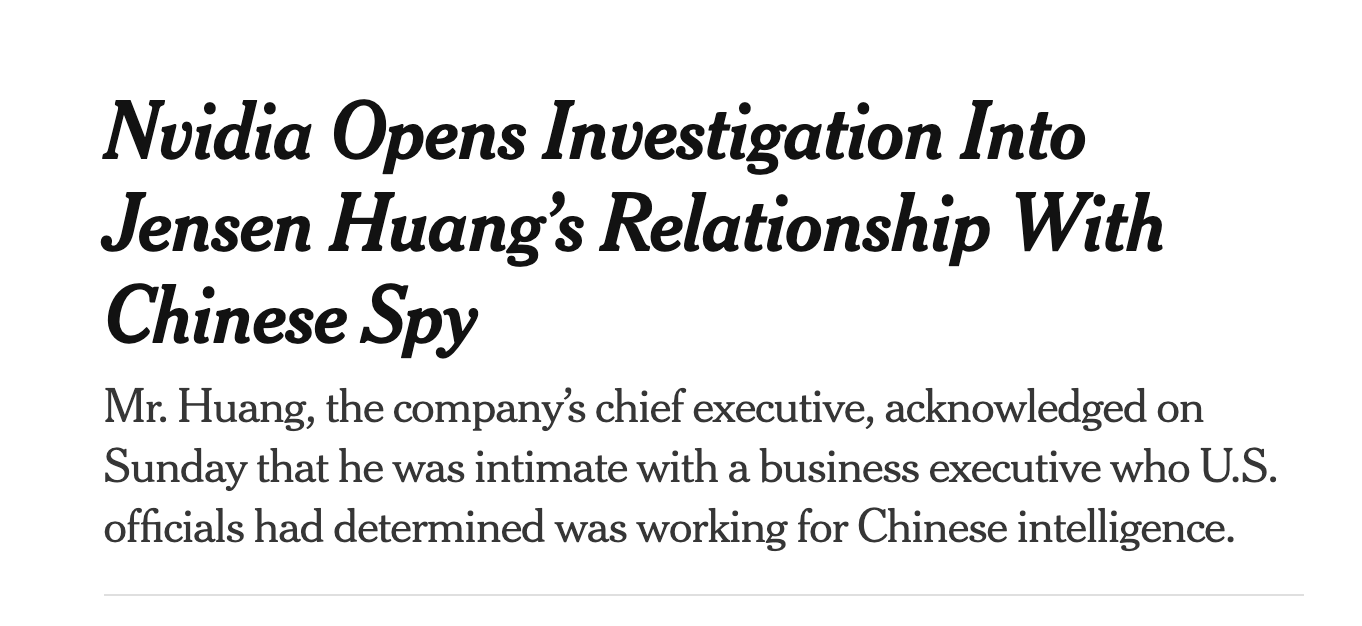
Another signal is that previously untouchable figures, like Nvidia’s CEO Jensen Huang, are being exposed by enemies over scandals that were likely known but kept under wraps.
And some billionaires, like Calacanis’ All-In co-host Chamath Palihapitiya, are now going on apology tours to curry favor with the incoming Democrats, largely because they want to remain relevant by maintaining access to power. Still, that’s a shift.
So the question presented by the midterms and the market correction two days later is whether businesses and investors will take voter anger seriously. Does the “midterm mandate” herald the generational shift in our politics that many are pointing to? Or will speculative industries continue to conduct moral hazard, with the safe assurance that if all goes awry, a bailout will come their way?
I don’t know the answer to those questions. None of us do. I am burned by the political betrayals of the last few decades, as are we all. I get why Wall Street expects nothing to change. But I’m also chronically optimistic, and just as it’s arrogant to imagine that Wall Street has been defeated, it is just as arrogant to dismiss the power of voters demanding something different.
Now, on to the full round-up of news. There are some incredible stories - Nvidia’s CEO Jensen Huang was caught having an affair with a Chinese spy, and that may deflate the AI bubble since Nvidia is at the center of the financing. Anthropic’s IPO is on the rocks, another existential moment. Plus Elizabeth Warren is likely to be Chair of the Banking Committee and has private equity on her mind. Oh, and CVS is preemptively breaking itself up to avoid regulatory scrutiny. All of that and more below the jump, for paid subscribers only.
If you haven’t yet joined as a paying subscriber, I’ll just note that this newsletter has had a big impact on policy. We helped coin the term “Break Up Big Medicine,” we’ve helped launch dozens of antitrust suits against fire truck makers, and we’ll be doing a lot of work in this new era to uncover and highlight the actual details of governance and corporate power that too often remain unexplored. So sign up. You won’t regret it.
Good News
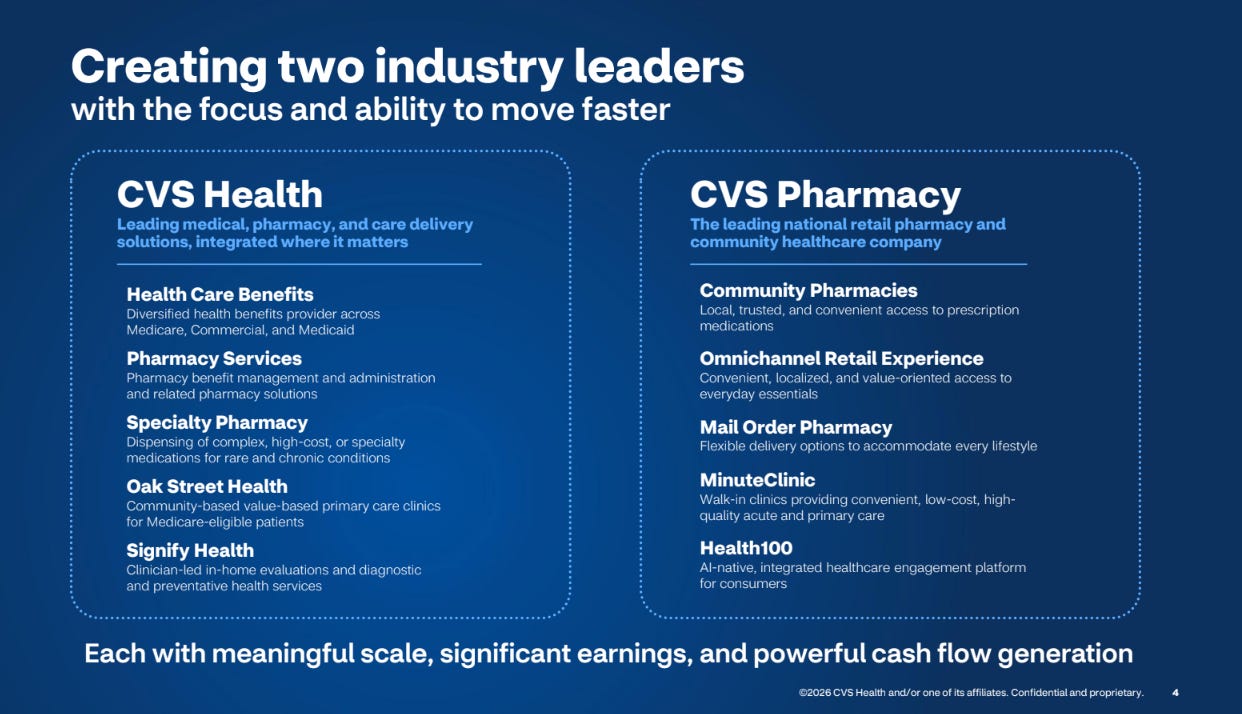
The Biggest Healthcare Breakup in History is Half the Story. The other major news of the week is that CVS Health is breaking up its $300 billion insurance arm + pharmacy benefit manager (PBM) from its $90 billion retail pharmacy line. So one company will now house the CVS insurance provider Aetna and PBM Caremark, and the other will house around 9,000 retail pharmacies.
It’s one of the largest corporate breakups in history, and even the Economist is heralding the end of vertical integration in healthcare. PBMs have become a regular reporting target of BIG, and a target of bipartisan Congressional hearings, bipartisan legislation from Senators Warren and Hawley, and state laws in Arkansas and Tennessee that forbid PBMs from also owning pharmacies. CVS is in court to overturn the Arkansas and Tennessee laws, and it’s unclear what if anything will happen to those cases, but other PBMs are challenging those laws, too.
This is very consequential, and it’s another data point in support of the notion that corporate breakups can in fact be good for business. One investor characterized it as CVS’ acknowledgment that “bigger isn’t always better.” But it’s also not being received well by many in the healthcare advocacy space who note that CVS is keeping its specialty pharmacy arm, while dumping its poor-performing retail pharmacy chains. Basically, CVS vertically integrated its pharmacy chain, playing a big part in decimating independent pharmacies across the country, and is now dumping it while holding onto its complex, high-cost, high-revenue pharmacy service. As one colleague tells me, “The Specialty Pharmacy staying in the PBM stack tells you everything you need to know.”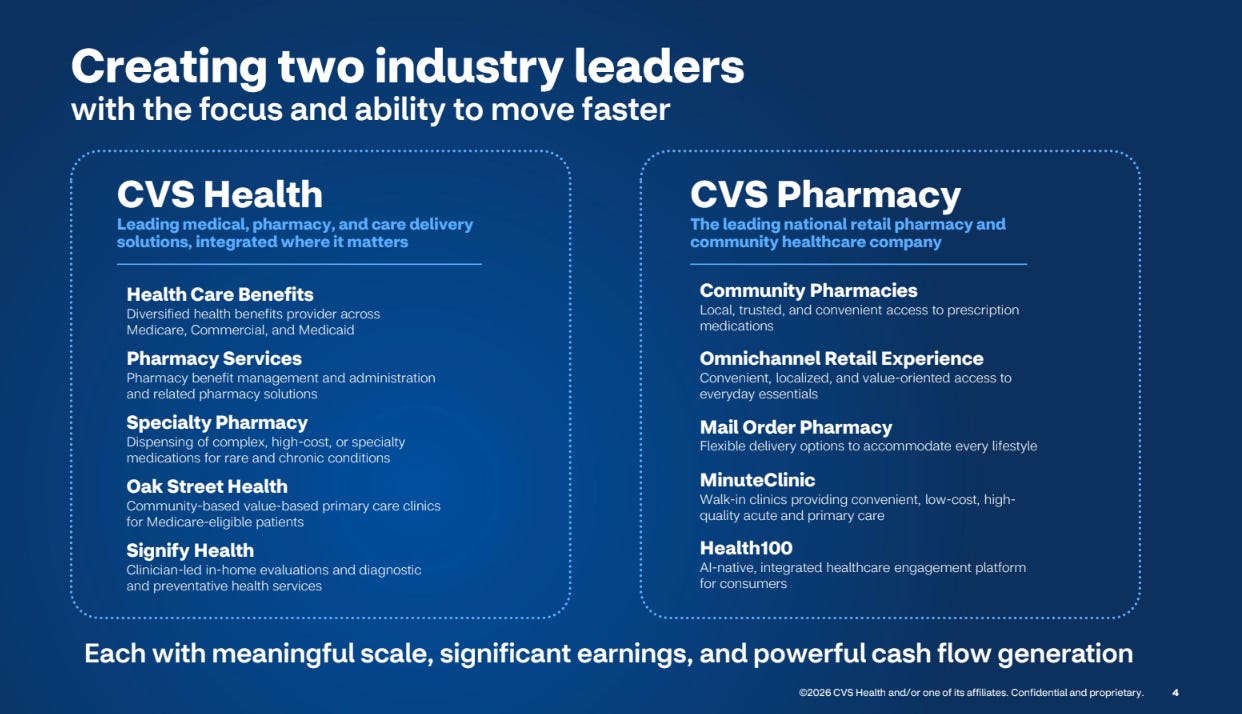
So everything else remains vertically integrated, including CVS’ health insurance plan and its PBM. Even if CVS won’t be steering patients to its own pharmacies, it still has power to engage in rebate schemes that drive up drug prices and healthcare premiums. The Pharmacy Guild is slamming CVS’ “smokescreen division plan,” too. So while a breakup is good to see, let’s not be fooled.
Many new members of Congress ran on a platform that included breaking up big medicine. There is good reason to keep up the momentum.
Here’s pharmacy advocate Dr. Glaucomflecken throwing flags on CVS’ breakup play:
The unemployment rate remains low, as the economy added an unexpectedly high 165,000 jobs in October. Productivity is also up 3.6%, but here’s the kicker: Labor’s share of productivity is at 53%, the lowest ever share since reporting began in 1947.
Elizabeth Warren is about to take over the Senate Banking Committee, and her priority is to take on private equity with the Stop Wall Street Looting Act. That would be a huge deal.
Meanwhile… “Four of the 10 candidates who received the most direct financial backing from employees of private-equity firms lost their races in Tuesday’s midterm elections.”The midterms have jeopardized the NCAA’s push to get an antitrust exemption and return to ruling college football.
The once-$2 trillion anticipated Anthropic IPO is being repriced by investors to the $1.5-$1.6 trillion range over concerns about slow revenue growth and data center opposition. Others are saying it could fall even further to the $1 trillion range. Here’s Jim Cramer:
Did you buy a ticket from a U.S. airline in the past four years? Antitrust powerhouse firm Hagens Berman is suing airline pricing cartel ATPCO for illegally price fixing airfares.
And we got the first scalp from the Paramount-Warner deal, incumbent Democratic Los Angeles Mayor Karen Bass, who supported the deal, lost to lefty Nithya Raman, who opposed it.
Nvidia CEO Jensen Huang has been caught sleeping with a Chinese spy, an executive at a Singapore-based company called Megaspeed that ostensibly diverted Nvidia chips to China. Huang has been pressing aggressively to loosen export controls on China, and it’s a well-known rumor that his company has been working to divert chips to Chinese shell companies. It is also the center of the AI circular financing parade.
Huang is now under investigation by the board of directors, and faces bipartisan skepticism in Congress over this behavior. Trump is standing by Huang, one of his closest advisors.
But because of the ugliness of this scandal, and the central place of Nvidia in the AI bubble, it could end up being a very big deal.Meta tried to invoke Section 230 immunity against a lawsuit alleging it engaged in deceptive practices to addict minors to its platforms… and lost.
Former Chief Counsel to the House Antitrust Subcommittee Slade Bond is launching Bond PLLC, a new Washington law firm focused on competition strategy, investigations and political intelligence. He most recently worked at plaintiffs antitrust firm Cuneo Gilbert Flannery & LaDuca.
Naomi Klein and Ilana Glazer wrote an op-ed calling for the “reckless” OpenAI and Anthropic IPOs to be blocked.
Tapestry, which the Federal Trade Commission blocked from acquiring its competitor Capri back in October 2024, ended the week up 14.20%. It’s up 185% since the acquisition was blocked.
NYC DCWP Commissioner Sam Levine lays out a theory of governance: “I think policymakers should not be afraid to confront complex problems with simple, bright line solutions.”
This is really cool. The Bloomberg Price Project (BPP) is a new effort to provide an alternative catalogue of prices to the Consumer Price Index, allowing for much more granular tracking of prices. This could be a major breakthrough in how we track inflation and pricing power, amid uncertainty around the CPI.
Dave Dayen and Matt Stoller’s Organized Money podcast is back with co-host Laurel Kilgour to discuss how private home listings are restricting access to home ownership: “The American Dream is Now a Private Listing.”
The House Judiciary Committee is urging potential investigatory targets not to shred documents, delete emails, or engage in any other preemptive obstruction of its forthcoming investigations:
And if you’re interested in being a part of that work, the House Judiciary Committee is hiring investigators.
An op-ed from former chief technologists of the FTC and CFPB, Stephanie Nguyen and Erie Meyer, argues against allowing investigations into the OpenAI-Hugging Face hacking incident to get derailed by fake concerns of “misaligned” or “rogue” agents.
Oracle has scrapped a $7 billion chip leasing contract with TencentAI under pressure from the Trump administration over China-related national security concerns.
Senator-elect James Talarico went on TV to talk about the 1971 Powell Memo, a foundational document for the disastrous tort reform movement. It’s a great speech and points toward an overdue comeuppance for the Chamber of Commerce.
Bad News
In a callback to the 19th Century railroad barons, the Brotherhood of Locomotive Engineers and Trainmen union unearthed a clip from a March 2026 conference featuring Union Pacific CEO Jim Vena threatening to raise rates on shippers who don’t support the merger of Union Pacific and Norfolk Southern. Here’s the brazen statement:
Congressional oversight committees had better sharpen their pencils on this one. Here’s a memo explaining why the Union Pacific-Norfolk Southern merger should be blocked.
The Trump Justice Department announced its approval of FOX Corporation’s $22 billion acquisition of connected smart-TV platform Roku. As with Paramount-Warner Bros., this is another merger to control media distribution infrastructure, which will ultimately allow FOX to discriminate between what content is transported through Roku’s distribution railways.
The Justice Department says it reached an “agreement” with FOX to carry non-FOX content on Roku for a period of 3 years, but the Justice Department has given up on filing enforceable consent decrees in court, knowing that doing so would open it up to judicial oversight under a Nixon-era anti-corruption law called the Tunney Act.
Fox has also partnered with the Trump Administration to match government contributions to Trump Accounts, up to $1,000, and has given $1 million to a “strategic alliance” with First Lady Melania Trump’s “Fostering the Future” initiative.Amazon is bad for small business. Newly unredacted records in the FTC’s case against Amazon for rigging its ad market reveal that Amazon secretly raised advertising prices by as much as 50% above auction results on ordinary days and by as much as 250% on major shopping days like Prime Day or Black Friday. During the 2022 holiday shopping season, Amazon secretly and successfully raised its surcharges to increase its revenue by $87 million worldwide.
SpaceX reportedly wants to buy Boost Mobile to build a hybrid cellular-satellite network that could catapult it into fourth place among the top U.S. wireless providers.
Big Tech’s lobbying arm, the Chamber of Progress, is pushing for Congress to investigate Trump, not corporations. Here’s a good expose on their plan.
Chamber of Progress is also circulating a memo to Hill Democrats on AI-related priorities, including consumer protection. The Chamber of Progress has tried to water down surveillance pricing bills across the country.
Meanwhile, Chamber of Progress funders Google and Meta are suing to block a recently-passed California law banning addictive features for users under the age of 16. The First Amendment right to target children with surveillance algorithms?
A new research study shows that major VC firms are increasingly converging on the same investments. Among the seven majors — Sequoia, a16z, Accel, Lightspeed, Bessemer, General Catalyst and NEA — a third of the seven’s money now goes into rounds with three or more of them, up from under 6% in every period before 2024.
Waymo? Maybe Way-no. Robotaxi growth threatens to put the future of transportation under the control of just a few, already-dominant tech corporations.
Marvell Technology, a data infrastructure chipmaker for AI data centers, is acquiring Lumentum, a data transmission firm, for $115 billion in an all-stock deal. But Marvell’s shares slid on the announcement over investor concerns about dilution and financing risk.
More AI dealmaking! OpenAI-backed Thrive Holdings, the spinoff of Josh Kushner’s Thrive Capital and holder of some 75 companies, has acquired physical security company ADT for $7.6 billion. The deal will bring AI into the home security space.
Expect more AI-related distortion in the 2028 election cycle, which is already underway. OpenAI’s chief global affairs officer Chris Lehane thinks the 2028 presidential election could be a defining moment for AI. Didn’t they just try this!?
Brave New Hellscape: A first-of-its-kind draft bill has been proposed to the Delaware legislature that would allow the creation of an Artificial Intelligence Company (AIC), a form of legal personhood for an entity that operates through an AI agent with no human at the controls.
Cyberattacks are hitting supermarket fridge systems across Europe.
That’s all I’ve got for now. Tell me what’s on your mind!