Welcome to the monopoly round-up. Lots of news, as usual. Nvidia CEO Jensen Huang’s downfall is the most important story of the week, by far, and we’re going to have a piece on that soon, taking a step back from the gossipy parlour intrigue and reframing this event in terms of the political and policy debates it is causing.
There was a lot of other important news this week, too, including a case to block a veterinary services merger that would affect every pet lover in the country, and some consequential leadership battles that could affect whether the new Congress tackles corporate power, as Senator Chris Van Hollen launches a bid to challenge Senator Schumer’s leadership.
But first, I want to discuss two major outages of key infrastructure that happened this week, the Microsoft Outlook collapse that caused a nationwide work stoppage on Thursday, followed the next day by the nationwide ground stop that prevented some 12,000 flights from taking off during a four hour period on Friday. As of this writing, thousands of flights are still being canceled, and stranded passengers are struggling to make it to their destinations.
When Will We Stop Tolerating the Inevitability of Failure?
The Microsoft and air traffic control outages hit like a one-two punch last week. And their scale was significant, because each of these systems are infrastructure for their respective clients and industries. Microsoft Outlook and the company’s suite of office products are staples of modern work, the technological infrastructure of government agencies, schools, for-profit and nonprofit corporations, the largest law firms in the country, and more. As of November 2026, there are about 450 million paid commercial subscribers to Office 365, and another 95 million paid consumer licenses.
A significant portion of those subscribers, over a half billion of them in total, saw their functions ground to a halt. One estimate put the cost of the outage, which lasted from 21-24 hours for various services, at $7 billion.

In this case, it was the failure of a single component of an automated health check that shut down one server, which redistributed that server’s traffic to other servers, which caused those servers to become overloaded and shut down, and so on and so on. Tech outages are not new or even rare, but the scale of interconnectedness and dependency means that the extent of harm caused by one missing puzzle piece is immense. It is a bit like we are in a giant bank run, except with industrial and technical systems.
Around 10 hours into the Microsoft outage, which became widespread around midday eastern time on Thursday, more than one group text I’m on had begun discussing what it would mean if Outlook just… never came back? That thought exercise is less about Outlook, our lives and work (inevitably) would continue, but about the possibility that every other system we rely on could be next.
Those discussions had hardly subsided when news broke that Federal Aviation Administration issued its ominous Friday the 13th order:
DUE TO EXTRAORDINARY CIRCUMSTANCES AND FOR REASONS OF SAFETY.
ATTENTION ALL AIRCRAFT OPERATORS, BY ORDER OF THE FEDERAL AVIATION
COMMAND CENTER ALL AIRPORTS ARE GROUND STOPPED.
For air traffic control, it was a failed router following a copper-to-fiber migration that triggered the flooding of other routers, imperiling radar and telecommunications systems. (Again, these are the current diagnoses, which may change as more information comes out.)
The Microsoft and air traffic control outages happened back to back and affected tens of millions of people across the country, so naturally there was speculation that the incidents were somehow related, that the United States had been the target of a ransomware or state-sponsored cyber attack, or that we were witnessing the early onset of broader societal disruption. The verdict may still be out on some of that.
Cascading Failures
As a technical matter, both the Microsoft Outlook outage and the FAA’s nationwide ground stop were attributed to “cascading failures” following technological upgrades. I like that term because it captures the domino-like phenomenon where a single glitch in the system can quickly spiral into an incapacitating social and economic crisis.
Cascading failures are what occur when systems are based on flawed and deeply interdependent technologies. The quintessential example is Chernobyl, where flawed systems and a culture of inadequate safety protocols created a hair trigger for one error to cause a disaster.
In his 1984 book “Normal Accidents: Living With High-Risk Technologies,” Charles Perrow introduced the idea that certain systems are so complex and so tightly interwoven that accidents are not merely possible, but inevitable. “Tightly-coupled” system design was how we got Three Mile Island, and even in 1984, Perrow saw how we were replicating high risk system design in the airline, maritime and space industries, with weaponry and medicine, and dams and mining. The obvious response is to create more resilience in our industrial infrastructure, to lessen the likelihood of such incidents and reduce the damage when they occur.
Despite Perrow’s diagnosis over 40 years ago, similar “interactive complexities” have become even more prevalent in the networked era of the last quarter century. It used to be that when you were having a tech problem, work would call in the IT guy to resolve some local server issue. Now we’ve constructed bespoke systems on top of remote servers and cloud-based infrastructure that are, predictably, concentrated choke points for systemic failure. Most businesses now outsource control over their own systems to large firms.
Indeed, our political economy architecture over the past forty five years encourages this kind of irresponsibility. First, there is a lack of liability for firms like Microsoft when they cause damage. Second, labor law doesn’t protect the engineers who know how to protect these systems. One clear root cause of cascading failures — the first domino of system collapse, which predates either of these incidents in isolation — is getting rid of workers who know best how to monitor for and mitigate risks.
Microsoft has laid off approximately 35,000 employees since October 2022, and in May 2025 laid off 3% of its entire workforce, disproportionately software engineers, while beefing up project management. Basically, the trend is toward replacing engineers, who understand the importance of reinforcing weaknesses in the foundation, with a bunch of well-paid efficiency hawks with a bias toward cutting corners on the path to rapid product delivery.
Meanwhile, Microsoft CEO Satya Nadella says that up to 30% of the company’s code is now written by software. That percentage is much higher at other companies, including Anthropic. Tech executives have recognized the risk associated with smaller teams having to scrutinize millions of lines of code they didn’t write, and products being shipped by managers who haven’t had time to review at all.
Another cause is weak antitrust law, which facilitates the creation of chokepoints. As BIG asked years ago in explaining the shortages during the post-Covid era, “What else is a monopoly but a business model designed to secure or create a bottleneck?”
It wasn’t necessarily done in bad faith; policymakers followed the lead of economists, who believed dominant firms were dominant because they were efficient. This faith in efficiency over all else meant that the public structuring of markets to force resiliency - aka regulation - was illegitimate. Alas, this philosophy has led to a series of bottlenecks in our supply chains, which are now global.
I wish we had learned from the post-Covid era, but it’s clear that we have still not re-architected key social infrastructure to become more resilient. Since 2021, it has gotten worse, with AI and cloud computing facilitating more centralization. Here’s investor Roger McNamee making that point:
Can Companies Manage Their Own Systems?
Five hours into its outage, Microsoft issued an optimistic update: “We're returning a portion of affected servers to the service, and they remain stable so far,” but followed it one hour later with, “The servers we returned to service can become unresponsive again once they receive traffic.”
These opaque updates and subsequent partisan finger-pointing suggested no one really knew what was going on. Microsoft itself explained to investors the nature of the problem. Highly interdependent systems magnify reliability issues, it said, while admitting that they are rolling out technology without adequate processes to detect defects:

There will be studies, the obligatory reports and investigations, but even if we arrive at some official technological consensus, the overriding perception is that the most important and dominant corporations in our society are deploying critical infrastructure without really knowing how it works.
Here’s another example, from Anthropic’s pre-IPO filing, which plainly states their models are developing at such a rate they may soon become incapable of monitoring for harmful conduct and misalignment:
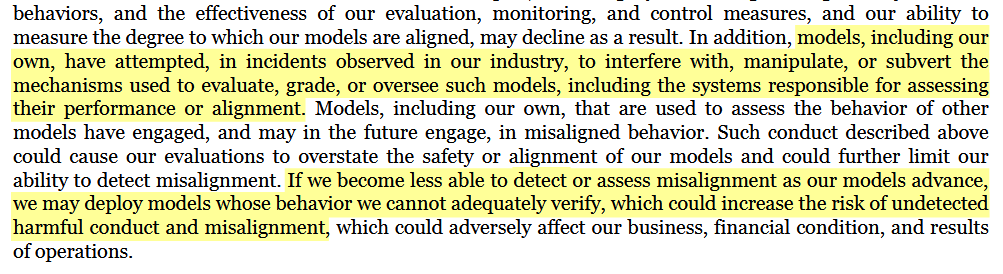
When you bet the entire house on technology that even its makers admit is unreliable, unsafe, and impervious to risk mitigation, and then something goes wrong, an outside observer might fairly ask, “What did you expect?”
But the problem isn’t isolated to private large corporations. We have ripped out the capacity of public institutions as well. Earlier this year, the FAA reduced its target number of air traffic controllers by 2,000 personnel, even though since 2015 the amount of air traffic has increased by 10% and the number of controllers has declined by 6%. Many controllers now work six day weeks with compulsory overtime. Nearly 11,000 air traffic controllers are still due months of back pay for a 2.8% raise granted by Congress, which the FAA refuses to pay.
Air traffic controllers are understaffed, overworked, and underpaid. We know this, yet are moving in the direction of making that problem worse. That’s the broader context in which the FAA announced, just three days prior to the outage, the nationwide rollout of its AI-assisted SMART system — despite concerns from Congress as to its safety and over the objections of air traffic control unions. I’m sure the timing is just a coincidence, nothing to see here, move right along, right? Or maybe, just maybe, it’s worth asking once again, What did you expect?

Broad systemic failures are avoidable, yet we’ve made them inevitable. It’s hard to imagine that changing any time soon, because we can’t expect to govern when we have given up on understanding how things work. And while this time it’s “just” Outlook, or “just” an annoyance isolated to people with the misfortune of having to travel this weekend, sometime soon it will be a much larger problem. The parallels to Chernobyl aren’t just theoretical. Nuclear power plants use Outlook, too.
There’s also just the Microsoft of it all. Microsoft is one of the enduring monopolies of the past 50 years, ever since it acquired the operating system called DOS in 1981 and wielded it to achieve monopoly control over personal computers. There’s a colloquial wisdom that Microsoft’s power has waned amid competition with the likes of Google and Apple, but it’s more accurate to say that Microsoft has burrowed itself into core markets — like enterprise communications software — through sticky procurement contracts that produce moral hazards through vendor lock-in.
If Microsoft’s refusal to improve the basic search indexing function of Outlook is a reflection of its insulation from competitive pressure, which it clearly is, then this week’s outage is even less surprising as a function of the lack of competitive pressure it faces to make its systems resilient.
The larger question here is whether policymakers have over-indexed on optimizing the efficiency of individual systems, which increases the vulnerability of larger, interdependent systems. That’s the way to think about cascading failures. It’s a critical concern not just for work emails and aviation, but for financial markets, telecommunications, energy, healthcare, and cloud computing.
One big lesson of the pandemic was single points of failure in supply chains were dangerous. They resulted in nationwide shortages of baby formula, medical contrast dye used in CT scans, and semiconductors used in automobile manufacturing. A society that prioritizes efficiency and scale, at the expense of resiliency and redundancy, is doomed to the inevitable stream of shortages, outages, and eventually even greater system collapse. In other words, we are going to restructure our corporate systems, it’s just a question of whether we do it deliberately, hiring the necessary people to manage the risk, or whether we do it after a collapse has harmed a lot more people.
Or to put it differently, we’ll know America is on the right path when Microsoft makes Outlook search actually work.
Now, on to the Good and Bad news of the week. Democrats are organizing around an agenda for the new Congress, one which centers economic populism, but not if leadership can’t create the pathways to govern. A shakeup is coming for the FTC, the Fox acquisition of Roku appears tainted by corruption, Chuck Schumer is facing a real challenge for Senate leadership, and much more below.
Good News
The Federal Trade Commission is stepping up to challenge the $3.5 billion merger of Covetrus and MWI, the two largest distributors of veterinary products and services, on the basis that it will cause higher prices for veterinary clinics and pet owners.
As covered in an earlier column this week, Western Union pulled out of its acquisition of Intermex after California’s Department of Financial Protection and Innovation conditioned its approval of the merger on consumer protection and pro-competition requirements.
More private enforcement of the Robinson-Patman Act, as multiple cases are proceeding against Walmart for allegedly causing Energizer, the battery company, to hike its wholesale prices on smaller retailers.
A price fixing lawsuit is being allowed to proceed against major memory chipmakers. That’s a big deal for anyone who buys electronics or video game systems.
Mayor Mamdani’s direct line to President Trump is continuing to pay off, as he just secured a delay in enforcement of a new rule requiring SNAP-authorized retailers to meet expanded stocking standards, giving bodegas and other small retailers an additional 90 days to comply.
Washington State’s utility is actually decreasing rates by 7.9 percent based on a decrease in the utility’s costs to deliver power to its customers. Price decreases are, in fact, possible.
Matt has been posting some really great explainers on Twitter/X about the dynamics of House and Senate leadership debates. On some level, the personality skirmishes matter less than how Congress is organized to govern.
Speaking of how to structure Congress for a pro-governance approach, here are some reform proposals from a group called the American Governance Institute. I’m trying to dig in on this stuff, so if you’re someone with expertise or institutional knowledge, send me a shout.
Youth sports clubs got the South Park treatment, and it’s spot on. I love when wonky corporate power stuff breaks cultural containment!
That said, here’s a welcome challenge to Senator Schumer’s bid for majority leader, from Senator Chris Van Hollen. As majority leader, Schumer was hostile to antitrust reform and apparently refused to meet with Lina Khan when she was FTC Chair.
A really good opinion piece in Capitol Forum opposing the largest railroad merger in history, of Union Pacific and Norfolk Southern, written by a former rail administrator under Biden.
The Consumer Federation of America is out with a blueprint for the 120th Congress, and it includes all sorts of stuff around surveillance pricing, corruption, and corporate power.
An event in DC this week called “Popular Mandate” brought together dozens of members of Congress to talk about how to take on corruption, big tech, and healthcare costs. These events are important ways to build capacity and a coherent agenda for the next Congress, and it’s further evidence that the midterms were about economic populism.
United Airlines is banning AI agents from booking flights, citing increased data privacy risks and avoidance of another middleman. I’m putting this under Good News, because there’s a lot of work yet to be done to mitigate the harms of agentic commerce, but there is some degree of financial self-interest by United Airlines in making it more difficult for consumers to navigate their abstract and confusing prices.
More people are starting to pay attention to the threat of vertical integration of AI infrastructure. Here’s a piece called “The New Standard Oil” by Grace Blakeley.
Last month, the FTC filed a consumer protection lawsuit against Dollar General alleging that shoppers were seeing one price on the shelf, and a different price at checkout. The practice was sweeping and rampant. Dollar General must now pay $63 million, basically a pittance for the retail giant, but I’m more interested in their obligation to set up an independently monitored pricing accuracy program. I’m putting this in Good News, but given how well independently monitored settlements have gone in the past, I’m not exactly holding my breath for a recidivist offender.
Bad News
It wasn’t just outages at Microsoft and air traffic control this week. The nationwide ground stop appears to have cascaded into Amtrak’s booking systems, which also overloaded and experienced technical issues.
Among the many lurid details surrounding the implosion of Jensen Huang’s Nvidia are allegations the company was lobbying Commerce Department officials to block their investigation of illegal chip smuggling.
Worse, Commerce Secretary Howard Lutnick’s former financial services firm, Cantor Fitzgerald, which is now led by his sons, has a $362.3 million stake in Nvidia, which makes up 7% of Cantor’s entire portfolio. It’s all so painfully and hilariously corrupt.
Republicans chose Jim Jordan to be their minority leader in the next House of Representatives. Jordan was one of the most hostile members in Congress to the antitrust enforcement efforts against Big Tech, opposed the Merger Filing Fee Modernization Act, and rigorously opposed Lina Khan’s merger enforcement efforts.
In one of their first major votes following the midterm elections, 11 Democrats failed to show up to impeach Department of War Secretary Pete Hegseth over his handling of the Iran War, which is one of the variables in the discourse around affordability. Not exactly a unified show of strength.
The Fed is all but certainly going to increase rates at its upcoming December 8-9 policy meeting. The only question is by how much, after inflation came in hotter than expected in the US CPI report. Prices excluding food and energy rising 0.3% from a month earlier – higher than the Federal Reserve would have wanted. Overall prices climbed 0.4%.
As I’ve been highlighting in recent columns, CPI is a shaky metric for overall economic health, particularly when consumption is being sustained disproportionately by high-income earners. Low-income working people will bear most of the burden of higher interest rates.A rocket operated by United Launch Alliance that was carrying 40 Amazon satellites malfunctioned, destroying the entire payload. Not a good sign for those wanting more competition to Musk’s SpaceX.
Boeing beat their Q3 revenue expectations, so of course they are announcing a 5% workforce reduction in their commercial airline division. Merry Christmas!
Fox’s acquisition of home TV distribution system Roku was approved by federal antitrust enforcers shortly after Fox gave $1 million to First Lady Melania Trump’s foster care initiative.
President Trump is tapping Chris Mufarrige for an appointment to the Federal Trade Commission. Mufarrige has been serving as director of the FTC’s Consumer Protection Bureau, and has spoken about the need for government to get out of the way of AI.
That’s all I’ve got. Let me know what’s on your mind!